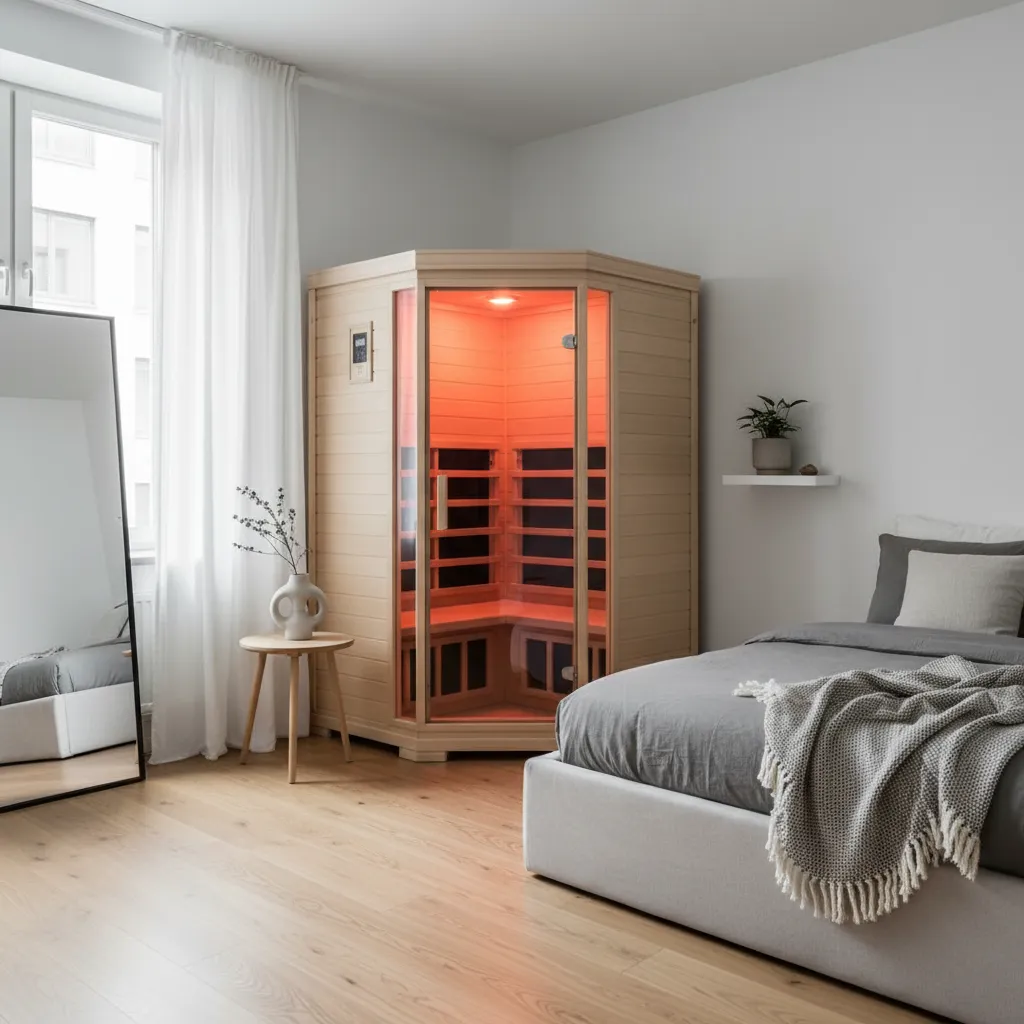
Best Sauna for Apartments and Renters (2026): What Fits
Compare apartment saunas by space, power and lease rules. Infrared and portable options, landlord approval, security deposits and the tradeoffs renters face.
Sauna Type
Quick answer: For most apartment and rental buyers, the best answer is a small infrared cabin or a portable setup. Traditional usually loses on power, ventilation, building rules, and neighbor tolerance. Renters have one more filter: what your lease and landlord will actually allow without putting your deposit at risk.
Best for
Apartment and condo buyers with limited space and limited room for installation mistakes, including renters who also have a lease and a security deposit to protect.
Wrong fit
Homeowners with a basement, garage, or backyard who can support a real traditional build.
Tradeoff
The easier the sauna is to fit into an apartment, the farther it usually gets from the classic sauna experience.
Apartment buying is less about the sauna you want in theory and more about what your building will tolerate in practice.
For most buyers, that means one of two lanes: small infrared or portable.
Interesting if you already know you want the portable premium lane
What apartment buyers need to solve first
Power. Can the unit run on standard household power, or does it quietly assume a more serious electrical setup?
Ventilation and moisture. Even infrared creates heat and enclosed humidity. Small rooms make mistakes feel bigger.
Building rules. Condo boards, landlords, and insurance questions matter here more than brand prestige.
Routine friction. If setup and storage are annoying, the sauna tends to become expensive furniture.
Best lane for most apartment buyers
Small infrared cabin
This is the strongest mainstream answer for most apartment buyers because it balances:
easier installation
more stable ownership than portable
gentler heat that suits a small indoor room
The right question is not "is infrared better?" It is "is infrared the best fit for this building and this routine?" In apartments, it often is.
Portable can still be the right answer
Portable wins when:
you rent and want the lowest-friction option, since a sauna blanket or tent needs no landlord conversation at all
budget is tight
you are not ready to commit to a full cabin
you mainly want to test whether the habit is real
Portable loses when you expect it to feel like a fully built sauna. It does not.
Avoid this if...
you are shopping traditional indoor saunas without a clear 240V plan
you live in a building with strict alteration rules
you think a beautiful product page solves moisture or ventilation
The apartment friction nobody likes to talk about
Electrical limits
Many apartments simply are not set up for a traditional electric sauna. If you need a dedicated 240V circuit and panel capacity is already tight, the decision can be over right there.
Noise and neighbor tolerance
Infrared is quieter. Portable is simpler. Outdoor is often impossible. These are not glamorous facts, but they matter more than a cedar finish.
Heat and moisture management
Small indoor rooms punish bad planning quickly. If you ignore airflow and room material limits, even a good sauna can feel like a bad purchase.
Renting? Here's What Actually Changes
If you rent, the sauna decision is not just about space. It is about what your lease allows, what your landlord signs off on, and what happens to your deposit when you move out. Lease and insurance guidance below checked September 14, 2026.
The three tiers your lease actually cares about
Tenant-rights guides consistently sort changes into three buckets, and real lease language matches the pattern. A 2026 tenant-modification guide from ReadYourLease puts it plainly: decorating needs no permission, alterations are usually reversible and need permission, and modifications touch the landlord's own wiring or plumbing and need written approval plus, often, a licensed contractor.
Setup
Tier
Landlord conversation
Sauna blanket or tent
Decorating
None needed. Plugs into a standard outlet, folds away, leaves nothing behind.
Portable cabinet (Durasage, SweatTent)
Decorating
Same as above: freestanding, plug-in, fully removable.
Small plug-in infrared cabin on a standard 120V outlet
Decorating to alteration
Usually no wiring change, but tell your landlord anyway. A few hundred pounds sitting on a shared floor is a floor-load and insurance question even without new wiring.
Infrared or traditional cabin needing a new 240V circuit or a dedicated 120V/30A line
Modification
Written approval required before an electrician touches the panel, and most leases restrict this kind of work outright for a rental. See our sauna permit requirements guide for what a permit adds on top of landlord sign-off.
What actually happens to your deposit
A landlord cannot deduct your security deposit for normal wear and tear, only for damage caused by misuse, negligence, or unauthorized work, and any deduction has to be itemized (Nolo's landlord-tenant guidance). The sauna itself is not the deposit risk. The risk is:
A wall anchor or mount you did not restore before moving out
Moisture damage from skipping the ventilation advice in a small, sealed room
Any electrical work done without your landlord's paperwork behind it
Photograph the space before you set anything up. Keep the setup freestanding wherever your format allows it. If your landlord does approve something semi-permanent, get the exact "what has to be restored at move-out" answer in writing before you buy, not after.
Does renters insurance cover it?
Standard renters insurance responds to personal property and liability, up to your policy's limits minus your deductible, for named perils including fire (Insurance Information Institute). The general guidance does not call out a sauna cabin or heater by name one way or the other, and we could not independently confirm a specific appliance exclusion for any single insurer. The honest move is to call your insurer, describe exactly what you are adding (plug-in or wired, wattage, cabin or blanket), and ask directly whether it changes your liability or personal-property coverage. Get the answer in writing or logged in your account notes. Do not assume either way.
For most apartment buyers, a small infrared cabin. It runs on standard household power, produces little moisture, and suits a small indoor room. A portable infrared unit is the better choice for renters or anyone testing the habit before committing.
Can you have a traditional sauna in an apartment?
Rarely in practice. A traditional electric sauna needs a 240V dedicated circuit and panel capacity most apartments do not have, plus ventilation a sealed unit cannot easily provide. If you do not have a clear 240V plan, this lane is usually closed.
Do apartment saunas need landlord or condo board approval?
It depends on the tier of change. A freestanding blanket, tent, or plug-in cabin on a standard outlet is a decorating-level change and usually needs no sign-off, though telling your landlord is still smart. Anything that touches the building's own wiring, like a new 240V circuit, is a modification and needs written approval before an electrician starts, and most rental leases restrict that kind of work outright. Confirm before you buy, not after it arrives.
Is a portable sauna good enough for an apartment?
It is the right choice when you rent, your budget is tight, or you want to test whether the habit sticks. It is a real infrared sauna, just not the full built-cabin experience. Expecting it to feel like a fixed cabin is the main way buyers end up disappointed.
Will installing a sauna hurt my security deposit as a renter?
Not by itself. A landlord can only deduct for damage beyond normal wear and tear, not for having owned a sauna. The real risk is unrestored wall anchors, moisture damage from ignoring ventilation advice, or electrical work with no paper trail. Photograph the space before setup and get any restoration requirement in writing if your landlord approves something semi-permanent.
Does renters insurance cover a home sauna?
Standard renters insurance covers personal property and liability up to your policy limits for named perils including fire, but the general policy guidance does not name a sauna cabin or heater specifically either way. Call your insurer, describe exactly what you are adding, and get their answer in writing rather than assuming it is covered.
These guides are built from manufacturer documentation, public specifications, primary research where health claims matter, and repeated buyer questions that show up in real ownership and installation decisions.
Manufacturer responses can clarify pricing bands, warranty terms, support footprint, or common mistakes. They do not move a page up the shortlist on their own.