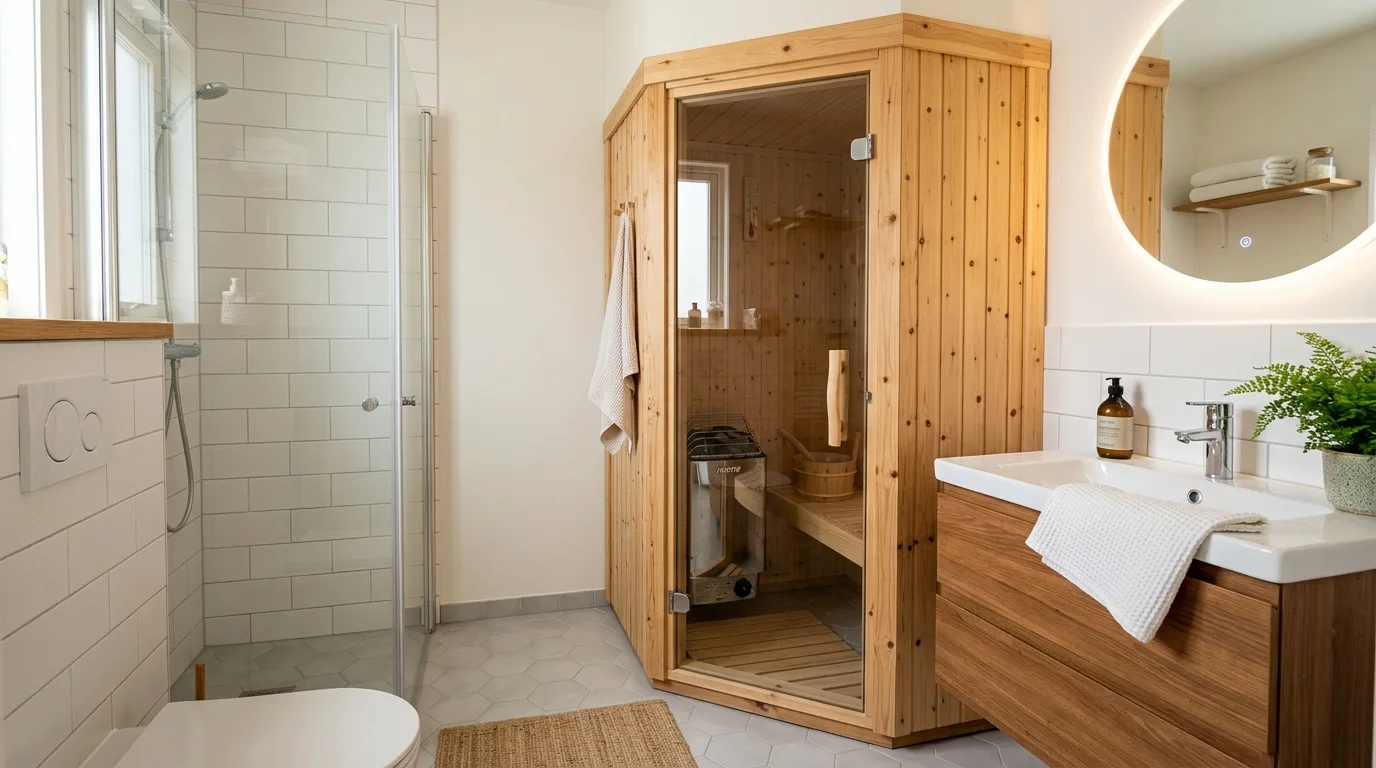
Sauna for Small Spaces (2026): What Fits and What to Skip
The best sauna options for small spaces in 2026. Real footprints, one-person and two-person cabins, portable units, and the tradeoffs nobody tells you about.
Quick answer: For a genuinely small space, a one-person infrared cabin or a portable infrared unit is almost always the right answer. They run on a standard outlet, fit in a closet-sized footprint, and create no moisture problem. A small traditional sauna is possible but rarely worth the build in a tight space.
Best for
Buyers with a spare corner, a small spare room, a large closet, or an apartment, who want a real sauna without a renovation.
Wrong fit
Buyers who want full traditional löyly and have a basement, garage, or yard that could support a proper build instead.
Tradeoff
The smaller and easier the sauna is to fit, the further it moves from the deep, steamy traditional experience. You are buying convenience, and that is a fair trade if you go in knowing it.
Most "small space" sauna disappointment comes from one mistake: buying the sauna before measuring the space honestly. A cabin that looks compact in a product photo still needs door-swing clearance, airflow around it, and a route to get the panels into the room in the first place.
Get the measuring right and a small-space sauna is one of the best-value wellness purchases you can make. Here is what actually fits.
Quick comparison: small-space sauna types
Type
Footprint
Power
Moisture
Best for
Portable infrared
Folds away, near zero stored
120V outlet
None
The tightest spaces, renters, trial buyers
One-person infrared cabin
~3 x 3 ft
120V outlet
Very low
A permanent solo sauna in a small room
Two-person infrared cabin
~4 x 4 ft
120V outlet
Very low
A small room you want to share occasionally
Compact traditional
~4 x 4 ft and up
240V circuit
Moderate
Buyers set on real heat who will build for it
Portable infrared: the smallest real option
A portable infrared sauna is a collapsible tent-style unit with your head outside and your body inside. It folds down to nothing when not in use, runs on a standard outlet, and produces no moisture.
It is not a luxury cabin and does not pretend to be. But for a renter, a buyer with no permanent space, or someone testing whether a sauna habit will stick before committing thousands, it is the most practical entry point. We cover the apartment case in detail in best sauna for apartment.
One- and two-person infrared cabins: the small-space sweet spot
This is the category that fits most "small space" situations well. A one-person infrared cabin needs roughly a 3 by 3 foot footprint. A two-person cabin needs about 4 by 4. Both run on a standard 120V outlet, so no electrician and no dedicated circuit. Moisture output is low enough that you do not need a vapor barrier.
Quality solo and compact cabins come from Clearlight Saunas and Health Mate, among others. If you might want to share it, the size step from one to two people is small, and the best 2-person sauna guide compares the options worth shortlisting.
Compact traditional: possible, rarely worth it in a tight space
You can buy a small traditional cabin. It will give you real heat and steam. But in a genuinely small space the build cost rarely pencils out: you still need a 240V dedicated circuit, a vapor barrier, and proper ventilation, just in a smaller box. The sauna electrical planning guide shows what that circuit involves.
If real traditional heat is non-negotiable, the better move is usually to find a slightly bigger space, like a garage or basement, rather than force a tight traditional build.
Before you buy: the small-space measuring checklist
1. Measure the real footprint, not the marketing footprint
Add door-swing clearance and a few inches of airflow gap on the sides and back. The number you need is the cabin footprint plus that clearance, not the cabin alone.
2. Check the path into the room
Most cabins ship as flat panels, but some compact units arrive more assembled. Measure doorways, stairwells, and turns. A cabin that fits the corner but not the doorway is a returned cabin.
3. Confirm the outlet
Most infrared cabins want a dedicated standard 120V outlet, not a shared one running a space heater too. Confirm the circuit can take it.
4. Plan a little airflow
Even infrared benefits from some air movement. A cabin jammed into a sealed closet with no gap will feel stuffy. Leave clearance and crack the room door, or add a small vent.
Common mistakes in small-space sauna buying
Measuring the cabin, not the clearance. The cabin fits. The cabin plus door swing plus airflow gap does not. Measure the real envelope.
Forgetting the delivery path. Doorways, tight stair turns, and elevators kill more small-space sauna plans than the room size does.
Forcing traditional into a closet. Real heat in a tight space means a full electrical and vapor-barrier build for a tiny room. The cost rarely justifies it. Infrared is the small-space answer.
What it actually costs
Component
Portable infrared
One- or two-person infrared cabin
Unit
$200-$900
$1,800-$5,500
Electrical work
$0 (existing outlet)
$0 (existing outlet)
Prep / clearance work
None
Minimal
Total realistic range
$200-$900
$1,800-$5,500
A small traditional build, by contrast, lands closer to $5,000 and up once the circuit, vapor barrier, and ventilation are included. The home sauna cost guide for 2026 breaks the full project down.
Plain recommendation
If the space is truly tight or you are renting, start with a portable infrared unit. Low cost, zero install, folds away.
If you have a small permanent spot and want a real cabin, a one- or two-person infrared cabin on a standard outlet is the small-space sweet spot. Quality, low risk, no renovation.
Only chase a small traditional build if real steam heat matters more to you than the cost and effort of building it into a tight room. In most small spaces, it does not.
FAQ
What is the smallest sauna that is still worth buying?
A one-person infrared cabin at roughly a 3 by 3 foot footprint is the smallest cabin that still feels like a real sauna. Below that, a portable infrared unit is the practical choice, and it is genuinely useful for renters and first-time buyers.
Can you put a traditional sauna in a small space?
Technically yes, but it rarely pays off. A compact traditional cabin still needs a 240V dedicated circuit, a vapor barrier, and ventilation. In a tight space the build cost is hard to justify versus a one- or two-person infrared cabin.
Do small infrared saunas need a special outlet?
Usually not. Most one- and two-person infrared cabins run on a standard 120V outlet, ideally a dedicated one rather than a shared circuit. Always confirm the exact requirement for the model you choose.
How much clearance does a small sauna actually need?
Plan for the cabin footprint plus door-swing clearance plus a few inches of airflow gap on the sides and back. Measuring only the cabin is the most common reason a "small space" sauna does not fit.
Is a portable sauna a real sauna?
It is a real infrared sauna in a collapsible form, not a traditional steam sauna. For renters, tight spaces, or testing whether the habit sticks before spending thousands, it is the most practical entry point. See best sauna for apartment for the apartment-specific case.
These guides are built from manufacturer documentation, public specifications, primary research where health claims matter, and repeated buyer questions that show up in real ownership and installation decisions.
Manufacturer responses can clarify pricing bands, warranty terms, support footprint, or common mistakes. They do not move a page up the shortlist on their own.