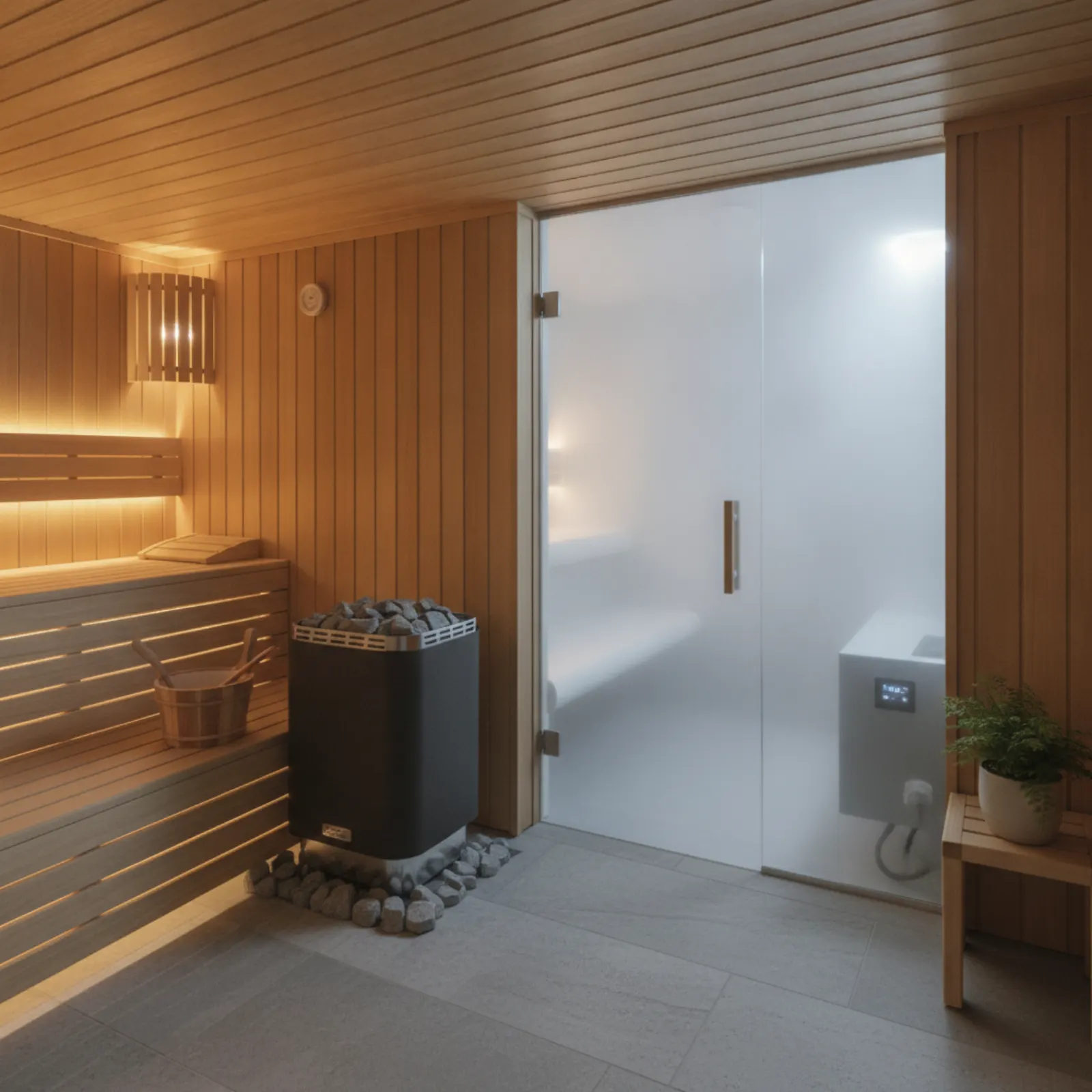
Sauna vs Steam Room: Cost, Heat and Which to Build
Sauna vs steam room compared on heat, humidity, build cost, maintenance, and health evidence, with a direct decision rule for home buyers.
Sauna Type
Quick answer: A dry sauna heats the air to 150-195F at low humidity. A steam room uses a steam generator to fill a sealed, tiled room with about 100% humidity at a lower 110-120F. A sauna is the simpler, drier home build. A steam room needs full waterproofing, a sloped ceiling, and ongoing mold control. And the famous heart-health research is on dry Finnish saunas, not steam rooms.
Best for
Buyers deciding between a dry sauna and a steam room for their home, who want the build, cost, and health reality, not just the spa-day version.
Wrong fit
Buyers who already know they want a sauna and just need to pick infrared vs traditional or a brand.
Tradeoff
A steam room delivers humid heat but is a wet, tiled, mold-prone build. A dry sauna is simpler to own and has the stronger long-term research.
Choose a dry sauna if you want the classic high-heat sweat, a simpler and drier build, and the heat therapy with the strongest long-term research behind it. Choose a steam room if you specifically want humid, lower-temperature heat that feels intense and soothes congestion, and you are prepared for a fully waterproofed, tiled, mold-prone build that costs more to keep up.
That is the fast answer. The longer one matters because these two get sold as interchangeable spa upgrades, and they are not. They heat you differently, they cost different amounts to build at home, and one of them carries health claims that were actually measured on the other. We don't sell either, so here is the version without the spa-brochure gloss.
Half the confusion here is vocabulary. Three terms get used loosely.
Dry sauna means a traditional sauna: a heater warms a tray of stones, the stones heat the air, and the air heats you. Humidity is low. This is what most people picture when they say "sauna."
Steam room (also called a steam bath or, loosely, a "steam sauna" or "wet sauna") is a different appliance. A steam generator boils water and fills a sealed, tiled room with near-total humidity at a much lower temperature. A steam room is not a sauna, and there is no wood in it.
Infrared sauna is a third category. Panels heat your body directly at lower air temperatures. You never pour water in one. If you want that comparison, it lives in infrared vs traditional sauna.
One more point that trips people up: pouring water on a traditional sauna's rocks, called loyly, makes a quick burst of steam and raises the humidity briefly. That is still a dry sauna. It is not the same as a steam room running at constant 100% humidity.
How Each One Works
The dry sauna
A traditional sauna heats the air to roughly 150 to 195 degrees Fahrenheit at low humidity, generally under 20 percent (Cleveland Clinic, 2024). Finnish sources run hotter, with the Finnish authorities citing 80 to 100 degrees Celsius, which is 176 to 212 Fahrenheit (thisisFINLAND). The heat is dry, the air is breathable if intense, and a session usually runs 15 to 20 minutes. You can throw water on the rocks for a short, sharp blast of humidity, then it fades.
The steam room
A steam room runs cooler but wetter: around 110 to 120 degrees Fahrenheit at 95 to 100 percent humidity, produced by a steam generator boiling water (Healthline, 2024). The walls, ceiling, and benches are tile or another sealed, non-porous surface, because everything is constantly wet.
Here is the part that surprises people. The cooler steam room often feels hotter than the dry sauna. At 100 percent humidity your sweat cannot evaporate, so your body loses its main cooling tool and the heat feels heavier. A 115-degree steam room can feel more intense than a 175-degree dry sauna.
Dry Sauna vs Steam Room, Side by Side
Factor
Dry Sauna
Steam Room
Heat source
Heater plus stones (electric or wood)
Steam generator boiling water
Temperature
150-195F (higher in Finland)
110-120F
Humidity
Under 20%, brief spikes with loyly
95-100%, constant
How it feels
Hot, dry, breathable
Cooler but heavier, sweat cannot evaporate
Enclosure
Wood, foil vapor barrier
Fully tiled and waterproofed
Home build
Simpler, drier
Bigger wet build, sloped ceiling, drainage
Maintenance
Stays dry, low mold risk
Runs wet, needs mold and mildew control
Long-term health research
Strong (on dry Finnish saunas)
Limited, no equivalent cohort
Best for
Classic high-heat ritual, recovery
Humid heat, a congested-feeling chest
What the Health Research Actually Shows
This is where the spa blogs get it wrong, and it is worth getting right because it is usually the reason people invest in one of these.
The famous "sauna is good for your heart" research is dry-sauna research. The landmark study followed 2,315 Finnish men for a median of 20.7 years and found that, compared with one session a week, men who used a sauna 4 to 7 times a week had about 63 percent lower risk of sudden cardiac death and roughly 40 percent lower all-cause mortality (Laukkanen et al., JAMA Internal Medicine, 2015). The study spells out the conditions: a traditional Finnish sauna with dry air at 10 to 20 percent humidity, 80 to 100 degrees Celsius. During a session, heart rate can rise to 120 to 150 beats per minute, similar to low-to-moderate exercise (BMC Medicine, 2018).
Steam rooms do not have an equivalent body of evidence. There is no long-term mortality or cardiovascular cohort on steam rooms. So when an article quotes the 20-year Finnish numbers next to a photo of a steam room, it is borrowing proof from a different machine. That does not mean a steam room is bad for you. It means the strong longevity case belongs to the dry sauna, and you should not buy a steam room expecting those specific results.
On the benefit steam rooms are most often sold for, congestion relief, the evidence is thin. A Cochrane review of heated, humidified air for the common cold concluded there was "no clear benefit or harm" (Cochrane, 2017). Some people get short-term relief from feeling stuffed up. It does not shorten a cold. And humidity is not universally good for airways: humid air can worsen some people's asthma, while dry or cold air triggers others. It is person-specific, not "steam equals healthy lungs." Neither room "detoxes" you either, which we cover in the sauna detox myth, and neither burns meaningful fat, covered in the sauna weight loss myth.
The Part the Spa Blogs Skip: What Each Costs to Build at Home
Comparison articles treat this as a lifestyle preference. For a home buyer it is a construction decision, and the two are not close.
A home steam room is a wet building project. It needs a steam generator, a fully waterproofed enclosure with a continuous vapor membrane behind every surface, non-porous tile on all walls and the ceiling, a sloped ceiling (the tile industry standard is 1 to 2 inches per foot) so condensation runs to the walls instead of dripping on you, plumbing to the generator, and drainage. The generator alone typically runs about $2,000 to $7,000 (ThermaSol retail, mid-2026), and an installed home steam shower or room commonly lands between $2,650 and $7,100 for a prefab setup and $4,000 to $14,000 for a custom build (Bob Vila, 2023).
Then there is upkeep. A steam room runs at roughly 100 percent humidity by design, which is exactly the sustained moisture that grows mold. The EPA recommends keeping indoor humidity under 60 percent and the CDC under 50 percent to control mold. A steam room blows past that every session, so it needs real ventilation and regular cleaning to stay healthy. That is an ongoing cost, not a one-time one.
A dry sauna is a simpler, drier build. It is a wood-lined enclosure (often Western red cedar) with a foil vapor barrier behind the panels and good ventilation. A prefab cabin or outdoor barrel is closer to an assemble-and-plug-in box. The real hidden cost is electrical: most traditional heaters need a dedicated 240V circuit, which usually runs $450 to $1,200 to install. We break that down in the electrical planning guide, and the full budget for a sauna is in the home sauna cost guide. Saunas range widely, from around $2,500 for a DIY or prefab kit to $15,000 and up for a custom outdoor build, but the drier, simpler enclosure and the lower mold burden are real advantages over a steam room.
The plain summary: a steam room is the heavier, wetter, higher-maintenance build, and a dry sauna is the simpler one to own. If you are picturing one going into a spare bathroom, that difference is the whole decision.
Who Should Be Careful
Both rooms raise your core body temperature, so the same cautions apply to each.
Pregnancy. Avoid raising your core body temperature, especially in the first trimester. Skip both unless your doctor clears it. More in who should not use a sauna.
Heart conditions and blood pressure. Heat dilates blood vessels and can drop blood pressure. People with unstable heart conditions, recent cardiac events, or very low blood pressure should check with a doctor first. See the sauna safety guide.
Asthma and lungs. Neither is automatically better. Humid air bothers some people, dry heat bothers others. If you have a lung condition, notice how each affects you and do not assume steam is the safe choice.
Both. No alcohol, stay hydrated, keep sessions to about 15 to 20 minutes, and step out if you feel lightheaded.
So Which Should You Build?
Buy a dry sauna if
you want the classic, hot, dry sauna ritual and recovery
you want the heat therapy with the strongest long-term research
you want the simpler, lower-maintenance build with less mold risk
you are putting it in a garage, basement, or backyard rather than tiling a wet room
Build a steam room if
you specifically want humid, lower-temperature heat and the way it feels on a stuffy chest
you are already renovating a bathroom and can absorb the tile, waterproofing, and sloped ceiling
you are fine with the ongoing mold and ventilation upkeep
For most home buyers who want heat therapy they will actually use and maintain, a dry sauna is the easier and better-supported choice. If that is your direction, the ultimate home sauna buying guide and the sauna brand directory are the next steps.
FAQ
What is the difference between a sauna and a steam room?
A sauna uses a heater and stones to heat dry air to 150 to 195 degrees Fahrenheit at low humidity. A steam room uses a steam generator to fill a sealed, tiled room with about 100 percent humidity at a lower 110 to 120 degrees. A sauna is dry heat in a wood room. A steam room is wet heat in a tiled room.
Is a dry sauna or steam room better?
It depends on what you want. A dry sauna gets hotter, is simpler and drier to build, has lower maintenance, and has the stronger long-term health research. A steam room runs cooler and wetter, can feel more intense, and some people prefer it for congestion. For a home install that you will maintain for years, a dry sauna is usually the more practical choice.
Which is hotter, a sauna or a steam room?
A dry sauna is hotter by temperature, 150 to 195 degrees versus about 110 to 120 in a steam room. But a steam room often feels hotter, because at near 100 percent humidity your sweat cannot evaporate, so your body cannot cool itself the way it does in dry heat.
Is a steam room good for your lungs?
It can feel soothing when you are congested, but the evidence is weak. A Cochrane review of heated, humidified air for colds found no clear benefit or harm. Humid air also worsens asthma for some people, while dry air triggers others, so it is individual. Do not treat a steam room as a proven respiratory treatment.
Can you put water on a dry sauna?
Yes, on a traditional sauna you ladle water onto the hot rocks, which the Finns call loyly. It creates a short burst of steam and raises the humidity briefly, then it fades. That is still a dry sauna. Never pour water in an infrared sauna.
Is a sauna or steam room better for weight loss?
Neither burns meaningful fat. Both make you sweat, so you lose water weight that comes back as soon as you rehydrate. If a brand sells either one as a fat-loss tool, treat that as a warning sign. The full breakdown is in the sauna weight loss myth.
These guides are built from manufacturer documentation, public specifications, primary research where health claims matter, and repeated buyer questions that show up in real ownership and installation decisions.
Manufacturer responses can clarify pricing bands, warranty terms, support footprint, or common mistakes. They do not move a page up the shortlist on their own.
Health and safety pages are written conservatively. When the safer answer is to slow down, get clearance, or skip the heat, that is the answer we give.