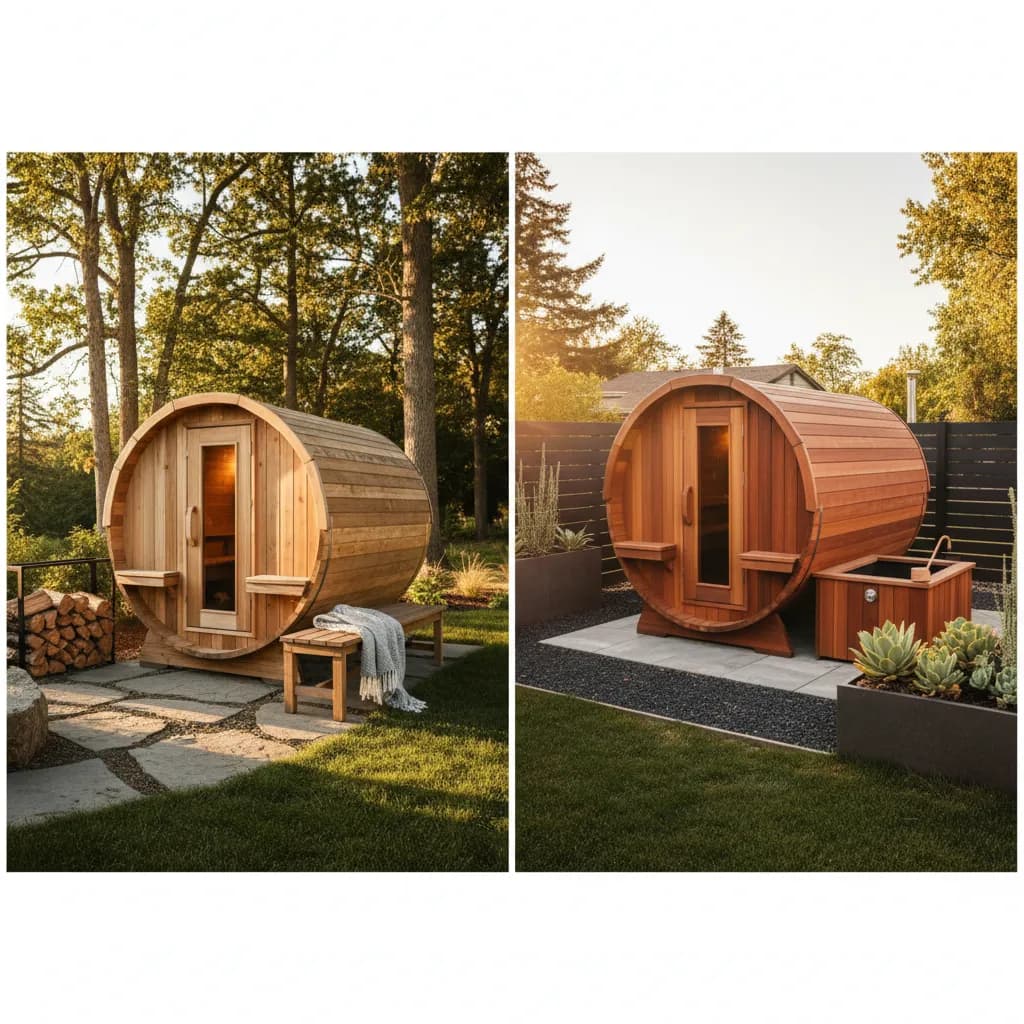
Almost Heaven vs Redwood Outdoors (2026): Which Sauna Wins?
Compare Almost Heaven vs Redwood Outdoors for 2026: real prices, cedar vs hemlock, warranty, shipping risk, and which outdoor sauna brand fits your backyard.
Comparison
Quick answer: For a cold-climate backyard, neither brand's compared 6-person barrel has insulated walls. Almost Heaven publishes a 1-3/8-inch stave thickness and uses Western Red Cedar, while Redwood does not publish its stave thickness but offers more heater headroom at up to 9kW. Choose Almost Heaven for the more inspectable shell and longer warranty. Choose Redwood for the simpler buying experience and 9kW option, but get its full warranty in writing.
Best for
Backyard buyers already comparing the two main US outdoor kit brands and trying to work out what the price gap actually buys.
Wrong fit
Buyers who still need to decide between outdoor and indoor ownership, or between traditional and infrared.
Tradeoff
Almost Heaven trades a higher list price and slower support for cedar and a longer (caveated) warranty. Redwood trades build pedigree and warranty depth for flat pricing and an easier buying process.
The short version: choose Almost Heaven if you want Western Red Cedar, a brand that has been shipping since 1979, and a limited lifetime shell warranty, and you can live with a slow support reputation. Choose Redwood Outdoors if you want flat predictable pricing at the common 6-person barrel size and a simpler direct-to-consumer buying experience, and you accept hemlock and a thinner published warranty.
This is not a pay-more-get-more-of-everything decision, which is the part most comparisons get wrong. The premium-priced brand here is the one with the weaker service record. Both ship flat as kits, both use Harvia heaters, and both leave the electrical work off the sticker. So the real choice comes down to three things: the wood, the warranty, and how much patience you have for support.
The Cold-Climate Answer in 30 Seconds
For the two 6-person barrels compared here, neither brand offers an insulated wall. Almost Heaven publishes a 1-3/8-inch stave thickness for the Huntington and builds it in Western Red Cedar. Redwood builds its barrel in hemlock but does not publish a stave thickness anywhere we could verify. Redwood offers more heater headroom, with a 9kW option against Almost Heaven's 8kW ceiling. Neither company publishes frost-depth or freeze-thaw foundation guidance.
If this matters most
Better fit
Why
Inspectable shell construction
Almost Heaven
It publishes the stave thickness and uses Western Red Cedar
Maximum heater headroom
Redwood Outdoors
Its available heater options reach 9kW
Long published cabin warranty
Almost Heaven
Limited lifetime shell coverage, with weathering and assembly exclusions
Smooth direct buying process
Redwood Outdoors
Simpler direct-to-consumer purchase path, but thinner published warranty detail
Insulated winter performance
Neither barrel
Move to an insulated cabin shortlist instead of forcing a barrel to do that job
Those facts were checked on the manufacturers' own pages on August 24, 2026. The full evidence and limitations are in the winter table below.
Huntington 4-6P canopy from ~$6,252 on current sale
Barrel 6P ~$6,299
Heater
Harvia electric
Harvia electric
Warranty
Limited lifetime on shell (exclusions apply), non-transferable
Not fully published, 30-day defect window on the refund policy
Service reputation
C- BBB, documented slow parts and support
Younger brand, DTC, service experience varies
Best for
Cedar and warranty length, if you tolerate slow support
Flat 6P barrel pricing and a clean buying flow
Prices are current sale pricing as of August 2026 and exclude electrical work. Almost Heaven's discount depth changes month to month, so always confirm the figure on the current product page before you order.
Price: closer than the tiers suggest
On paper Almost Heaven is the premium brand and Redwood is mid-range, but the entry prices overlap. Redwood's cheapest unit is the Haven 3-person indoor at $4,699 now that the Solo 1-person has been discontinued, and Almost Heaven's indoor cabins start near $4,200.
The size most backyard buyers actually want is the 6-person barrel, and this is where the picture has moved. Redwood lists its base 6-person barrel at $6,299, but as of August 24, 2026 that exact model and every one of its heater-package variants show as out of stock on Redwood's own site. The version currently available to order is the Barrel Sauna with Porch at $6,999, a $700 jump over the flat price this page previously compared against. Almost Heaven's comparable Huntington canopy barrel lists at $8,932 but sells for about $6,252 under the current sale, which wipes out the usual gap entirely against Redwood's base price, and undercuts the in-stock porch model outright. When the discount is shallower the Huntington has run $1,500 or so above the Redwood, and that premium buys cedar, the canopy, and the longer warranty. Whether that is worth it is the whole question on this page, so check live stock and price on order day, not the number in this paragraph.
Neither price includes the part that surprises people. A traditional outdoor sauna heater needs a dedicated 240V circuit, and running power to a backyard build commonly adds $2,000 to $3,000 on top of the kit. Read the home sauna cost guide for 2026 before you set a budget, because the electrical is the single biggest hidden line in an outdoor sauna.
Materials and climate: cedar vs hemlock
This is the clearest real difference between the two. Almost Heaven builds in Western Red Cedar, which is naturally resistant to rot, moisture, and insects. For a box that lives outside through every season, that resistance is worth real money over a decade. Redwood Outdoors, despite the name, builds its saunas in hemlock. Hemlock keeps the price down and is fine for the structure, but it is less naturally weather-hardy than cedar for year-round outdoor exposure.
One caveat that applies to both, and to every barrel sauna: the wood moves with humidity. Almost Heaven owners report stave gaps and minor leaking in variable climates, with the steel bands needing a retighten every 3 to 6 months as the wood swells and shrinks. That is normal barrel behavior rather than a defect, but it is real maintenance you should expect from either brand. If you want less wood movement, a cabin format moves less than a barrel. The barrel sauna vs cabin sauna guide walks through that tradeoff.
Cold-climate backyard: what actually changes in winter
Neither brand builds an insulated wall for its 6-person barrel. That is the fact this comparison skipped before, and it matters more than the wood species once you are heating a box in freezing wind. We checked both manufacturers' own product and specification pages directly on August 24, 2026.
Factor
Almost Heaven Huntington (6-person barrel)
Redwood Outdoors 6-person barrel
Stave/wall thickness
1-3/8 in, published on the product page
Not published anywhere on Redwood's site, including its design and dimensions FAQ
Insulated wall option
None offered on this model
None offered on this model
Heater options
Harvia electric, 6kW or 8kW, 240V, hardwired 30/40A service
Harvia KIP or Harvia Spirit, 6kW or 8kW, plus a 9kW Homecraft H-Series option, 120V for lighting and 240V for the heater
Brand-level heat-up claim
165°F in 30-40 minutes, 185°F in under 60 minutes
160°F in about 30 minutes, 190°F in under 1 hour
Winter heat-up guidance
"Give your sauna a little more time to heat up" in a northern winter; no specific added minutes
May need more than 60 minutes to preheat in colder months; restart the cycle to keep climbing, especially with a full stone load
Foundation guidance
Concrete pad (3-4 in), gravel bed (4-6 in), an existing deck, or pavers; site must be flat and well-drained
Concrete pad, solid deck, compacted gravel, or a paver patio; base must support the full loaded weight
Frost-depth or freeze-thaw guidance
Not published
Not published
Both heat-up figures are brand-level marketing claims, not a measurement on the Huntington or this specific Redwood barrel, and neither brand publishes a colder-climate percentage adjustment, just a qualitative "it will take longer." Treat both numbers as a starting point, not a promise for your yard.
The one real construction difference we could verify is stave thickness, and it only runs one direction: Almost Heaven publishes 1-3/8 in for the Huntington, and Redwood does not publish a stave thickness for its barrel anywhere we could find, on the product page, the design and dimensions page, or its FAQs. That does not mean Redwood's staves are thinner. It means only one brand lets you check.
Heater headroom is the other real difference. Redwood's 9kW Homecraft option gives more reserve capacity than Almost Heaven's 8kW ceiling on the Huntington, which is worth asking about if your winters run well below freezing. Run your actual room volume, glass area, and wall type through the heater size calculator before you pick a kW, rather than assuming bigger is automatically correct.
Neither company publishes a frost-depth or freeze-thaw base spec for this size, so that decision falls to your site and your local code, not the sauna kit. The outdoor sauna foundation guide covers frost heave and base design, and best sauna for cold climate has the wider shortlist, including insulated-panel options from other brands, if you decide an uninsulated barrel is not worth the winter tradeoff.
Warranty and support: read this before you pay
Almost Heaven offers a limited lifetime warranty on the sauna against manufacturing defects. The catch is in the exclusions: it does not cover normal weathering, improper assembly, or weather damage, and it does not transfer to a second owner. The Harvia heater is covered separately, 1 year on elements and 5 years on other parts, and coverage applies only inside the contiguous United States. The bigger issue is service. Almost Heaven carries a C- BBB rating with documented weeks-long waits for support and parts, assembly instructions that have conflicted with the owner's manual, and heaters that have shipped unwired. The product can be excellent and the after-sale experience can still test your patience, so budget time, not just money.
Redwood is the opposite shape of risk. The buying experience is cleaner and direct-to-consumer, but the warranty terms are not published in full on the site. There is a warranty hub that links to product-specific PDFs, and the public refund policy gives a 30-day window after delivery for defective-product claims. Before you order from Redwood, request the full sauna and Harvia heater warranty documents in writing so you know exactly what is covered and for how long.
Shipping and assembly
Both brands ship freight as a kit on a pallet, and both route damage claims through your delivery paperwork. Inspect the crate for freight damage before you sign for it, and photograph everything as you unpack, because a note on the delivery receipt is what protects you if a panel arrives cracked. Plan for two people and the better part of a day to assemble either kit, more if you hit the documentation issues Almost Heaven owners have flagged.
Our Take
For the buyer who wants the most durable outdoor shell and the longest warranty, and who can tolerate slow support if something goes wrong, Almost Heaven is the stronger long-term build. Cedar earns its premium outdoors.
For the buyer who wants a 6-person barrel for the lowest credible price and a smoother buying experience, Redwood Outdoors is the better value, as long as you get the warranty documents in writing first and accept hemlock instead of cedar.
Either way, get the kit price and the electrical quote in the same conversation. The brand you pick matters less than walking in with the real all-in number.
FAQ
Is Almost Heaven or Redwood Outdoors better?
It depends on what you are optimizing for. Almost Heaven is the better build for year-round outdoor use because it uses Western Red Cedar and backs the shell with a limited lifetime warranty, but its service reputation is weak. Redwood Outdoors is the better value at the 6-person barrel size and has a cleaner buying experience, but it uses hemlock and does not publish full warranty terms. Cedar and warranty point to Almost Heaven, price and buying experience point to Redwood.
Almost Heaven vs Redwood Outdoors, which is cheaper?
It moves with Almost Heaven's sale depth, and with what Redwood has in stock. Redwood's entry points are the $4,699 Haven indoor and the $5,899 Duo outdoor (the Solo 1-person is discontinued), while Almost Heaven's indoor cabins start near $4,200 and the Salem barrel near $4,037. At the popular 6-person barrel, Redwood's base model lists at $6,299 but was out of stock as of August 24, 2026, leaving its $6,999 Barrel Sauna with Porch as the in-stock option. Almost Heaven's Huntington at about $6,252 on the current sale undercuts both, though the Huntington runs $1,500 or so higher than Redwood's base price when the discount is shallower. Neither price includes the 240V electrical work, which commonly adds $2,000 to $3,000.
Which is better for a cold-climate backyard, Almost Heaven or Redwood Outdoors?
Neither publishes an insulated wall for its 6-person barrel, so this is not a case where one brand wins on winter engineering. Almost Heaven publishes a 1-3/8 in stave thickness for the Huntington; Redwood does not publish a stave thickness anywhere on its site. Redwood offers more heater headroom, up to 9kW against Almost Heaven's 8kW ceiling. Both give a brand-level heat-up claim (Almost Heaven: 165°F in 30-40 minutes; Redwood: 160°F in about 30 minutes) and both only say winter cold "will take longer" without a specific adjustment. Neither states a frost-depth or freeze-thaw foundation spec, so that part of the decision comes from your site and local code, not the kit. See the full comparison table above.
Are Almost Heaven barrel saunas worth the premium?
For an outdoor build in a real climate, the cedar and the warranty length are the case for the premium. The knock is service, not the product: a C- BBB rating, slow parts, and documentation that has tripped up assemblers. If you value the wood and the warranty more than a fast support line, it is worth it. If smooth service matters most, weigh that before you pay.
Do these saunas need electrical work?
Yes. Both use a traditional Harvia electric heater that needs a dedicated 240V circuit, and running power to a backyard sauna commonly adds $2,000 to $3,000 on top of the kit price. Get an electrician to quote the circuit before you commit to either brand, and read the home sauna cost guide for 2026 for the full all-in math.
We could not verify a published stave/wall thickness for Redwood's barrel, a frost-depth or freeze-thaw base spec from either brand, or a model-specific (rather than brand-level) heat-up time for either the Huntington or Redwood's barrel.
These guides are built from manufacturer documentation, public specifications, primary research where health claims matter, and repeated buyer questions that show up in real ownership and installation decisions.
Manufacturer responses can clarify pricing bands, warranty terms, support footprint, or common mistakes. They do not move a page up the shortlist on their own.