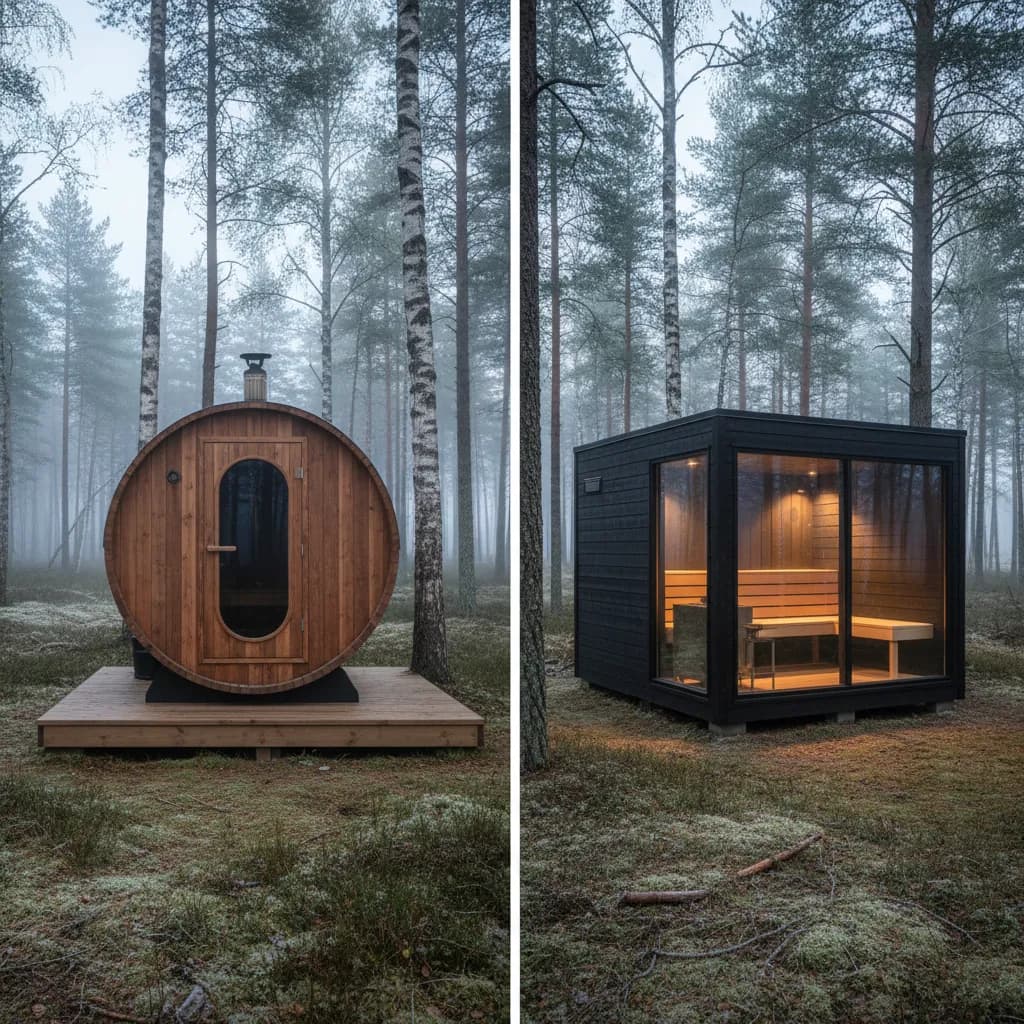
Barrel Sauna vs Cabin Sauna: Which One Is Right for You?
Barrel sauna or cabin sauna? Side-by-side comparison of cost, heat-up time, capacity, durability, and climate performance to help you choose.
Comparison
Quick answer: Barrels are simpler and often cheaper. Cabins make more sense in harsh climates, for longer sessions, and for buyers who care more about comfort than the barrel look.
Best for
Outdoor buyers comparing the two main backyard build styles.
Wrong fit
Anyone still deciding whether they want an outdoor sauna at all.
Tradeoff
Barrels usually win on simplicity and price. Cabins usually win on comfort, layout, and winter performance.
You have decided on an outdoor sauna. Good call. Now comes the fork in the road: barrel or cabin?
They look completely different, cost different amounts, and perform differently in cold weather. The wrong choice means either overspending for features you do not need, or freezing in January because your sauna cannot keep up.
This guide puts both options side by side so you can decide in five minutes.
TL;DR
Factor
Barrel Sauna
Cabin Sauna
Cost (all-in)
$5,000 - $11,000
$7,500 - $19,000+
Heat-up time
20 - 35 min
30 - 50 min
Realistic capacity
2 - 4 people
2 - 8 people
Footprint
6 x 6 ft typical
8 x 10 ft+ typical
Assembly
Kit, 1 - 2 weekends
More complex, may need contractor
Best climate
Mild to moderate
Any, including extreme cold
Durability
10 - 15 years with maintenance
15 - 25+ years
Insulation
Minimal (single-wall wood)
Full wall insulation possible
Interior layout
Curved walls limit options
Flat walls, flexible benching
Foundation
Gravel pad or pavers
Concrete pad or posts recommended
The short version: Barrel saunas win on cost, speed, and simplicity. Cabin saunas win on capacity, cold weather performance, and long-term durability. If your winters drop below 0 degrees F regularly, lean toward a cabin. If you want a sauna in the backyard this month for around $6K all-in, a barrel will get you there.
How Barrel Saunas Work (And Why They Heat Fast)
A barrel sauna is not just a marketing shape. The curved interior creates a natural convection loop. Hot air rises along the curved ceiling, rolls down the sides, and cycles back to the heater. Less dead air space means less volume to heat. A 6-foot barrel holds roughly 150 cubic feet of air. A comparable cabin holds 300 or more.
That is why barrels heat up in 20 to 35 minutes. You are heating half the air volume.
Barrel Sauna Strengths
Lower entry cost. Most barrel sauna kits from established brands land between $4,000 and $7,000 for a 2 to 4 person unit. Almost Heaven's entry Salem barrel starts around $4,000 on its near-permanent sale with a 6kW Harvia heater included, and Dundalk's cedar barrel kits start just under $6,000 with the heater sold separately. Add $200 to $500 for a gravel foundation and you are done.
Faster assembly. These come as kits with pre-cut staves. Two people with basic tools can assemble one in a weekend. No framing, no insulation, no vapor barrier. The staves lock together with metal bands.
Smaller footprint. A 6-foot barrel sits comfortably on a 6 x 6 foot pad. If your yard is tight, this matters.
Iconic aesthetic. There is no way around it. Barrel saunas look great. They photograph well, they become a conversation piece, and they have that Nordic character that a rectangular box does not.
Barrel Sauna Weaknesses
Curved walls limit your interior. You cannot mount benches flat against curved surfaces the same way you would against a flat wall. Upper bench depth is narrower, and lying down is awkward unless you buy a longer (8-foot) model. For taller users, this gets uncomfortable.
Single-wall construction. Most barrel saunas are just 1.5 to 2 inches of solid wood. No insulation cavity. In mild climates, this is fine. In Minnesota or Manitoba, your heater fights the cold all session. Heat loss is significant below about 10 degrees F.
Wood stave maintenance. The exterior staves are fully exposed to weather. Cedar resists rot well, but it still needs treatment every 1 to 2 years. If the staves dry out and shrink, gaps appear. The metal bands need tightening. Neglect maintenance for a few years and you have an expensive planter.
Capacity ceiling. Barrels max out around 4 to 6 people, and even that is tight. If you host sauna sessions with friends, you will outgrow a barrel quickly.
How Cabin Saunas Differ
A cabin sauna is essentially a small building. Four walls, a roof, a door. Think of it as a tiny house designed for heat.
Cabin Sauna Strengths
More usable interior space. Flat walls mean proper L-shaped or tiered benching. You can build a two-level bench system where the upper bench hits 190 degrees F and the lower bench offers a milder option for beginners or kids. This flexibility is a big deal for families.
Better insulated. A proper cabin has framed walls with insulation (R-13 or higher), a vapor barrier, and interior paneling. This makes a massive difference in cold climates. The heater works less, the sauna holds temperature longer between sessions, and your energy costs drop. For a detailed comparison of heating options, see our wood-fired vs electric sauna guide.
Room to customize. Want a changing room? A window overlooking the lake? A covered porch? A cabin gives you those options. Try adding a changing room to a barrel.
More heater choices. Cabins accommodate wall-mounted electric heaters, floor-standing wood burners, or designer wall units like the Huum Drop. Barrels typically limit you to compact electric or small wood stoves.
Longer lifespan. A well-built cabin sauna with a proper roof, foundation, and exterior treatment can last 25 years or more. Some Finnish cabin saunas are still in use after 50 years.
Cabin Sauna Weaknesses
Higher cost. Budget $6,000 to $13,000 for a quality cabin kit or prefab. Custom-built cabins with changing rooms and porches easily reach $20,000 or more. That does not include the foundation, which adds $500 to $2,000 depending on your approach.
Larger footprint. A 2-person cabin needs an 8 x 8 foot pad minimum. A 4-person with a changing room wants 8 x 14 feet. If your yard is small, the math might not work. Check our home sauna size guide for detailed dimensions.
More complex assembly. Even a "kit" cabin requires framing walls, installing insulation and vapor barrier, and possibly roofing. Many buyers hire a contractor for at least part of the build. See our DIY vs kit vs pre-built guide for realistic timelines.
Permits. Because a cabin sauna looks like a structure, your municipality is more likely to require a building permit. Barrel saunas often slide under the radar as "temporary structures" (though this varies by jurisdiction and you should always check).
Climate: The Factor Most Buyers Underestimate
This is where the decision often gets made.
Mild climates (Pacific Northwest, Mid-Atlantic, UK, Southern Europe). Either works fine. A barrel heats up fast, holds temperature adequately, and costs less. Go barrel unless you need more than 4-person capacity.
Cold climates (Upper Midwest, Canada, Scandinavia, Mountain West). Cabin wins. When it is -20 degrees F outside, a single-wall barrel sauna struggles. The heater runs at full power the entire session and still might not hit 180 degrees F on the upper bench. An insulated cabin reaches target temperature and holds it.
Some barrel sauna owners in cold climates add aftermarket insulation wraps. These help, but they look terrible and defeat the aesthetic advantage of the barrel shape. If you know your winters are harsh, budget for a cabin from the start.
Hot climates (Southern US, Australia). Barrels all the way. You do not need insulation when the ambient temperature is 70 degrees F. Heat-up is even faster, and the lower cost makes more sense since you will probably use it less frequently in summer months.
Real Cost Breakdown: All-In Numbers
Sticker price is not what you actually pay. Here is what "all-in" looks like for each.
Use this decision matrix. Find the row that matches your situation.
Your Situation
Go With
Why
Budget under $6,000
Barrel
Cabin projects rarely land below $7,500 all-in
Harsh winters (below 0 degrees F)
Cabin
Insulation is not optional in real cold
Small yard (under 100 sq ft available)
Barrel
Fits a 6 x 6 ft pad
Want to host 4+ people
Cabin
Barrels get cramped past 4
Want it built this month
Barrel
Kit assembly in 1 - 2 weekends
Want a changing room
Cabin
Barrels are one room, period
Prioritize low maintenance
Cabin
Proper roof and exterior last longer
Prioritize aesthetics
Personal call
Both look great, just differently
Plan to add cold plunge
Either
Both pair well with outdoor tubs
Might move in 3 - 5 years
Barrel
Easier to disassemble and relocate
Brand Recommendations
Barrel saunas.Almost Heaven is the most widely available in North America. Solid cedar construction, reasonable pricing, and good customer support. Dundalk Leisurecraft is the Canadian alternative with similar quality. Almost Heaven's 4-person and 6-person barrels run about $6,100 to $7,200 with a Harvia heater included, while Dundalk's barrel kits run about $6,000 to $8,200 with the heater sold separately.
Cabin saunas. This is a broader market. For kits, Harvia sells cabin packages in Europe and parts of North America. Finnleo sells dealer-only, and its panel-built NorthStar 4x6 outdoor cabin is listed around $13,000 at authorized dealers. For custom builds, local sauna builders who specialize in Finnish-style construction will deliver the best result, but expect $15,000 or more.
What is the difference between a barrel sauna and a cabin sauna?
A barrel sauna is a round, horizontal cylinder: less air volume to heat, so it warms up faster and costs less, but the curved walls mean tighter bench space and it loses heat faster in hard winter. A cabin sauna is a boxed structure with flat walls: more usable interior, better insulation and heat retention, room for proper bench tiers and more people, at a higher price and a bigger footprint. Barrel wins on value and heat-up speed; cabin wins on space, comfort, and cold-climate performance.
Is a barrel sauna worth it?
Yes, if your expectations match what a barrel delivers. For a solo or couples sauna in a mild climate at a reasonable budget, a barrel is an excellent choice. It is not worth it if you need high capacity, live in extreme cold, or want a multi-room setup.
How long does a barrel sauna last?
With proper maintenance (annual wood treatment, band tightening, stone replacement), a cedar barrel sauna lasts 10 to 15 years. Neglect the wood and that drops to 5 to 8 years. Red cedar lasts longer than white cedar or pine, and it is not the only wood that holds up outdoors; see our sauna wood types guide for how it compares to hemlock and thermally modified wood. For maintenance details, see our maintenance guide.
Do you need a foundation for a barrel sauna?
You need a level surface, but not a concrete foundation. A compacted gravel pad with landscape timbers works well and costs under $400. The key is drainage. Water pooling under the barrel will accelerate rot.
Can you use a barrel sauna in winter?
Yes, but performance depends on your climate. Down to about 20 degrees F, most barrel saunas perform well. Below 0 degrees F, expect longer heat-up times (45 minutes or more) and a harder time maintaining temperature on the upper bench. Below -20 degrees F, you are fighting physics.
Do barrel saunas need permits?
It depends on your jurisdiction. Many areas classify barrel saunas as temporary or accessory structures that do not require permits. Cabin saunas are more likely to trigger permit requirements because they look like permanent buildings. Always call your local building department before buying. The call takes five minutes and can save you thousands in fines.
Sources
Finnish Sauna Society technical guidelines on sauna construction
Almost Heaven Saunas product specifications and installation manuals
Dundalk Leisurecraft product specifications
Harvia sauna design documentation
International Association of Plumbing and Mechanical Officials (IAPMO) residential sauna standards
Thinking about a home sauna? Get our free buyer's guide: what it actually costs, what actually matters, and what everyone gets wrong. No sales pitch. Send me the guide.
Methodology
These guides are built from manufacturer documentation, public specifications, primary research where health claims matter, and repeated buyer questions that show up in real ownership and installation decisions.
Manufacturer responses can clarify pricing bands, warranty terms, support footprint, or common mistakes. They do not move a page up the shortlist on their own.