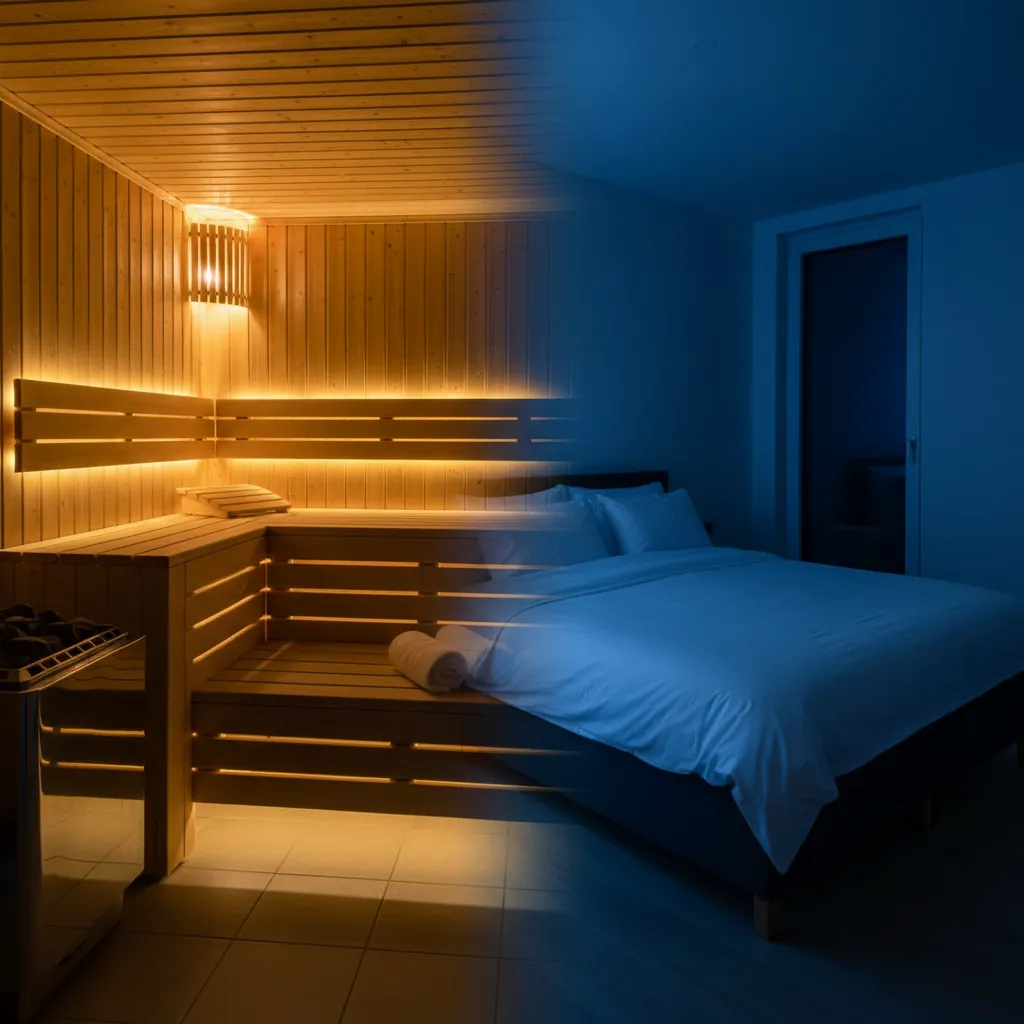
Sauna Before Bed: How Evening Heat Improves Sleep Quality
The science of sauna and sleep. How an evening sauna session can help you fall asleep faster, sleep deeper, and wake up more rested.
Quick answer: An evening sauna session helps you fall asleep faster and sleep deeper, and timing is the key variable. Finish a 15 to 20 minute session at moderate heat 1 to 2 hours before bed, so your core temperature can drop, which is the signal your brain uses to ramp up melatonin. A 2019 meta-analysis found that passive body heating 1 to 2 hours before bed shortened sleep-onset time by about 36 percent. Going too hot, too long, or too close to bedtime works against you.
Best for
Poor sleepers and evening sauna users who want a concrete pre-bed routine built on the temperature-drop mechanism.
Wrong fit
People on sleep medication or with heart conditions who have not cleared evening sauna use with a doctor, or anyone expecting a cure for chronic insomnia.
Tradeoff
The same session that primes deep sleep at 9 PM can delay sleep if taken right before bed, because the cool-down window is where the benefit happens.
It is 11 PM. You are in bed, phone face-down on the nightstand, eyes open, mind racing. You ran through your day, your to-do list, that email you forgot to send. Sleep feels close but unreachable. So you pick up the phone. Just to check one thing. Twenty minutes later you are deep in a scroll hole and further from sleep than when you started.
There is another way to end the day.
Picture this instead: two hours before bed, you step into a sauna. Fifteen minutes in the warmth. No phone, no noise, no input. Just heat and quiet breathing. Afterward, a cool shower. Then you sit for a few minutes and let your body cool. By the time you get into bed, your eyelids are heavy, your muscles are soft, and your mind has nothing left to say.
This is not a theory. It is physiology. Your body has a built-in mechanism that connects warmth to sleep, and a sauna session in the evening activates it powerfully. Here is how it works, what the research says, and exactly how to do it.
TL;DR: Sauna and Sleep
What
Detail
Does sauna improve sleep?
Yes. Research shows improved sleep quality, faster sleep onset, and increased deep sleep.
Best timing
1-2 hours before bed. Not immediately before.
How long
15-20 minutes at moderate temperature.
The mechanism
Core temperature rises in the sauna, then drops rapidly afterward. That drop signals your brain to produce melatonin and initiate sleep.
Traditional or infrared?
Both work. Infrared may feel gentler for evening use.
What to avoid
Sessions that are too hot, too long, or too close to bedtime.
The Science: Why Warmth Makes You Sleepy
Your body temperature is not constant. It follows a daily rhythm, rising during the day and falling in the evening. That evening drop is one of the strongest signals your brain uses to initiate sleep. When your core temperature falls, your brain ramps up melatonin production, your heart rate slows, and your body shifts into sleep mode.
A sauna session creates an artificial, accelerated version of this cycle.
Here is what happens: you sit in the heat and your core temperature rises by 1-2°F (0.5-1°C). Your blood vessels dilate. Blood flow shifts to your skin surface to release heat. When you leave the sauna, your body overcorrects. It dumps heat rapidly. Your core temperature drops below where it was before you entered.
That drop is the key. It is the same signal your body uses at sunset, just stronger and faster. Your brain reads it as: time to sleep.
The "Warm Bath Effect"
A landmark 2019 meta-analysis from the University of Texas at Austin screened 5,322 records on passive body heating and sleep and analyzed 17 studies that met its criteria. They found that raising core body temperature 1-2 hours before bed consistently shortened sleep-onset latency (the time it takes to fall asleep) by an average of 36%.
The researchers called it the "warm bath effect." The principle is simple. Warm your body, then let it cool, and you fall asleep faster. While the study focused primarily on warm baths, the mechanism is identical for saunas. In fact, the effect may be stronger with sauna because the temperature differential is greater.
Deep Sleep: Where the Real Recovery Happens
Falling asleep faster is useful. But the deeper benefit of pre-sleep sauna use is what happens after you fall asleep.
Deep sleep (also called slow-wave sleep) is the most restorative phase. This is when your body repairs muscle tissue, consolidates memories, releases growth hormone, and clears metabolic waste from the brain. Most adults do not get enough of it, especially as they age. Deep sleep naturally declines starting in your 30s.
Research on evening heat exposure shows that it can increase deep sleep significantly. Studies have found that passive body warming before bed increases slow-wave sleep by up to 70% in the first two hours of the night. That is a meaningful increase for something that requires no medication, no supplements, and no effort beyond sitting quietly in a warm room.
What Regular Users Report
Survey data from sauna communities consistently shows that sleep improvement is one of the most commonly reported benefits. Approximately 83% of regular sauna users report better sleep quality. Among those who specifically sauna in the evening, the numbers are even higher.
This aligns with what sleep researchers have observed: the combination of heat exposure, deep muscle relaxation, and reduced sympathetic nervous system activity creates ideal conditions for high-quality sleep.
Optimal Timing: When to Sauna for Sleep
Timing matters more than temperature or duration. Get this right and everything else falls into place.
The Sweet Spot: 1-2 Hours Before Bed
Your sauna session should end 1-2 hours before you plan to fall asleep. This gives your body enough time to complete the cooling process that triggers melatonin release and sleep onset.
If you go to bed at 10:30 PM, finish your sauna session between 8:30 and 9:30 PM.
Why Not Right Before Bed?
If you step out of a sauna and immediately get into bed, your core temperature is still elevated. Your heart rate is up. Your body is in active cooling mode, not sleep mode. You might feel relaxed, but physiologically you are still in a mildly stimulated state.
Give your body time to cool. This is the part most people skip, and it is the part that makes the biggest difference.
What About Morning Sauna?
Morning sauna sessions have their own benefits. They can boost alertness, improve circulation, and set a positive tone for the day. But they do not directly improve that night's sleep the way an evening session does. The temperature drop mechanism is time-sensitive. For a full breakdown of morning versus evening sessions, see our morning vs evening sauna guide.
Traditional vs Infrared Sauna for Sleep
Both types work for sleep improvement. The mechanism is the same: raise core temperature, then let it fall. But there are some practical differences worth knowing.
Traditional Sauna
Higher air temperatures (170-200°F / 75-95°C)
More intense cardiovascular response
Some people find the higher heat energizing rather than calming
The stronger stimulus may work better for people who need a more dramatic cool-down to trigger sleepiness
Infrared Sauna
Lower air temperatures (120-150°F / 50-65°C)
Gentler, more gradual core temperature rise
The experience tends to feel more relaxing and less intense
Many people report feeling deeply sleepy after infrared sessions
May be better for people who are new to sauna or sensitive to high heat
For evening use, many people prefer infrared. The gentler heat feels more aligned with winding down. But this is personal. Some people fall asleep best after the deep flush of a traditional session. Experiment with both if you have access. Read our infrared vs traditional sauna comparison for a full side-by-side.
A Simple Evening Sauna Ritual
Here is a step-by-step evening routine built around sauna and sleep. It takes about 45 minutes from start to finish.
Step 1: Prepare (5 minutes)
Drink a glass of water. Set out your sleep clothes. Turn down the lights in your bedroom. This is not just practical. It signals to your brain that the wind-down has started.
Step 2: Shower and Enter (2 minutes)
Take a quick, warm rinse. Step into the sauna. No phone. No podcast. If you want sound, choose something ambient and wordless, or just listen to the silence.
Step 3: Sit in the Heat (15-20 minutes)
Temperature: 160-180°F (70-82°C) for traditional. 130-145°F (54-63°C) for infrared. You do not need extreme heat for the sleep effect. Moderate is plenty.
Sit or lie down. Breathe slowly. If your mind wanders, let it. This is not meditation. There are no rules. Just warmth and quiet.
Step 4: Cool Down (5-10 minutes)
Step out and take a cool shower. Not freezing. Cool. The contrast helps your body release heat faster, which accelerates the temperature drop that triggers sleepiness.
If you enjoy cold exposure, a brief cold plunge works here too. But keep it short. You want to feel calm, not shocked. Our contrast therapy guide has detailed protocols if you want to go deeper.
Step 5: Rest and Rehydrate (10-15 minutes)
Put on comfortable clothes. Drink water or herbal tea. Sit somewhere quiet. This is the golden window. Your body is actively cooling, melatonin is building, and your nervous system is shifting into parasympathetic mode.
Many people describe this as the most peaceful part of their day.
Step 6: Bed
By the time 1-2 hours have passed since your session, your body temperature has dropped to its lowest point. Your eyelids are heavy. Your muscles are loose. Sleep comes easily.
What to Avoid: Common Mistakes
Going Too Hot
For sleep purposes, you do not need to push the temperature. Extreme heat can be stimulating rather than calming. If you come out of the sauna feeling wired and alert, the temperature was probably too high for an evening session. Dial it back.
Going Too Late
A sauna session 20 minutes before bed can actually make it harder to fall asleep. Your core temperature needs time to drop. Give yourself at least an hour, ideally 90 minutes to 2 hours.
Going Too Long
Longer is not better for sleep. A 15-20 minute session is ideal. Extended sessions (30+ minutes) increase dehydration and can leave you feeling drained rather than rested. You want to feel pleasantly warm and relaxed, not exhausted.
Dehydration
Dehydration disrupts sleep quality. It can cause nighttime waking, headaches, and restless sleep. Drink water before and after your session. This is simple but critical.
Sauna vs Hot Bath for Sleep
Both work. The mechanism is the same: passive body heating followed by cooling. The Texas meta-analysis that showed a 36% improvement in sleep-onset latency included both baths and other passive heating methods.
However, there are practical differences.
Sauna advantages for sleep:
Higher heat creates a larger temperature differential, which may produce a more pronounced cool-down effect
The dry heat and quiet environment are more conducive to mental calm
Sessions are shorter (15-20 minutes vs 30+ minutes for a bath to reach equivalent core temperature change)
No setup or cleanup
Bath advantages:
Available in every home
More accessible for people without sauna access
The act of lying in water is inherently relaxing
If you have access to a sauna, it is probably the more effective option. If you do not, a hot bath (104-108°F / 40-42°C) for 20-30 minutes, finishing 1-2 hours before bed, will give you much of the same benefit.
Who Should Be Careful
Evening sauna is safe for most healthy adults. But a few groups should approach with extra caution.
People on sleep medications. Some sleep medications lower blood pressure and slow heart rate. Combining these with sauna heat, which also affects blood pressure, can cause excessive drops. Talk to your doctor before combining the two.
People with low blood pressure. The post-sauna cool-down can lower blood pressure further. If you already run low, you may feel dizzy or faint. Start with shorter, cooler sessions and see how your body responds.
People with certain heart conditions. The cardiovascular effects of sauna are generally beneficial, but anyone with a heart condition should have medical clearance before starting a sauna routine. This is especially true for evening sessions, when the body is already in its natural wind-down phase. See our full sauna safety guide and when not to sauna guide.
People who run hot at night. If you already overheat in bed, timing is everything. Make sure your session ends early enough that your core temperature has fully dropped before you get under the covers.
Frequently Asked Questions
Can sauna replace sleep medication?
Sauna is not a substitute for prescribed medication. If you are on sleep medication, do not stop taking it without your doctor's guidance. However, many people find that a regular evening sauna routine reduces their reliance on sleep aids over time. Discuss this with your healthcare provider.
How many times per week should I sauna for better sleep?
Even one evening sauna session per week can improve sleep quality on that night. For a consistent effect, 2-4 evening sessions per week is a good target. Finnish research shows that higher frequency correlates with greater overall health benefits, including sleep.
Will sauna help with insomnia?
There is promising evidence. A small study on insomnia patients found that passive body heating before bed significantly improved sleep quality and reduced the time needed to fall asleep. Sauna is not a cure for chronic insomnia, but it can be a valuable tool alongside other sleep hygiene practices.
Is it okay to sauna every night before bed?
For most healthy adults, yes. Daily sauna use is common in Finland and has a long safety record. The key is staying hydrated and keeping sessions moderate. If you feel drained rather than refreshed, you may be doing too much. Listen to your body.
Does the type of sauna matter for sleep?
Both traditional and infrared saunas improve sleep through the same core mechanism. Choose whichever feels more relaxing to you in the evening. Many people prefer infrared for its gentler heat, but traditional saunas work just as well.
Final Thoughts
Sleep is not a problem to solve. It is a state your body already knows how to enter. The challenge, for most of us, is getting out of the way. Turning off the noise. Letting the nervous system shift from doing to resting.
The sauna does not force sleep. It creates the conditions where sleep happens naturally. The warmth, the quiet, the temperature drop afterward. These are ancient signals. Your body recognizes them. It has been responding to firelight and cooling night air for hundreds of thousands of years.
You do not need a complicated protocol. You need fifteen minutes of warmth, an hour of cooling, and permission to stop doing things before you close your eyes.
Close the door. Let everything go.
Sources
Haghayegh, S., Khoshnevis, S., Smolensky, M. H., Diller, K. R., & Castriotta, R. J. (2019). Before-bedtime passive body heating by warm shower or bath to improve sleep: A systematic review and meta-analysis. Sleep Medicine Reviews, 46, 124-135.
Horne, J. A., & Reid, A. J. (1985). Night-time sleep EEG changes following body heating in a warm bath. Electroencephalography and Clinical Neurophysiology, 60(2), 154-157.
Laukkanen, T., Kunutsor, S. K., Khan, H., Willeit, P., Zaccardi, F., & Laukkanen, J. A. (2018). Sauna bathing is associated with reduced cardiovascular mortality and improves risk prediction in men and women. BMC Medicine, 16(1), 219.
Hussain, J., & Cohen, M. (2018). Clinical Effects of Regular Dry Sauna Bathing: A Systematic Review. Evidence-Based Complementary and Alternative Medicine, 2018.
Krauchi, K., Cajochen, C., Werth, E., & Wirz-Justice, A. (1999). Warm feet promote the rapid onset of sleep. Nature, 401(6748), 36-37.
Thinking about a home sauna? Get our free buyer's guide: what it actually costs, what actually matters, and what everyone gets wrong. No sales pitch. Send me the guide.
Methodology
These guides are built from manufacturer documentation, public specifications, primary research where health claims matter, and repeated buyer questions that show up in real ownership and installation decisions.
Manufacturer responses can clarify pricing bands, warranty terms, support footprint, or common mistakes. They do not move a page up the shortlist on their own.
Health and safety pages are written conservatively. When the safer answer is to slow down, get clearance, or skip the heat, that is the answer we give.