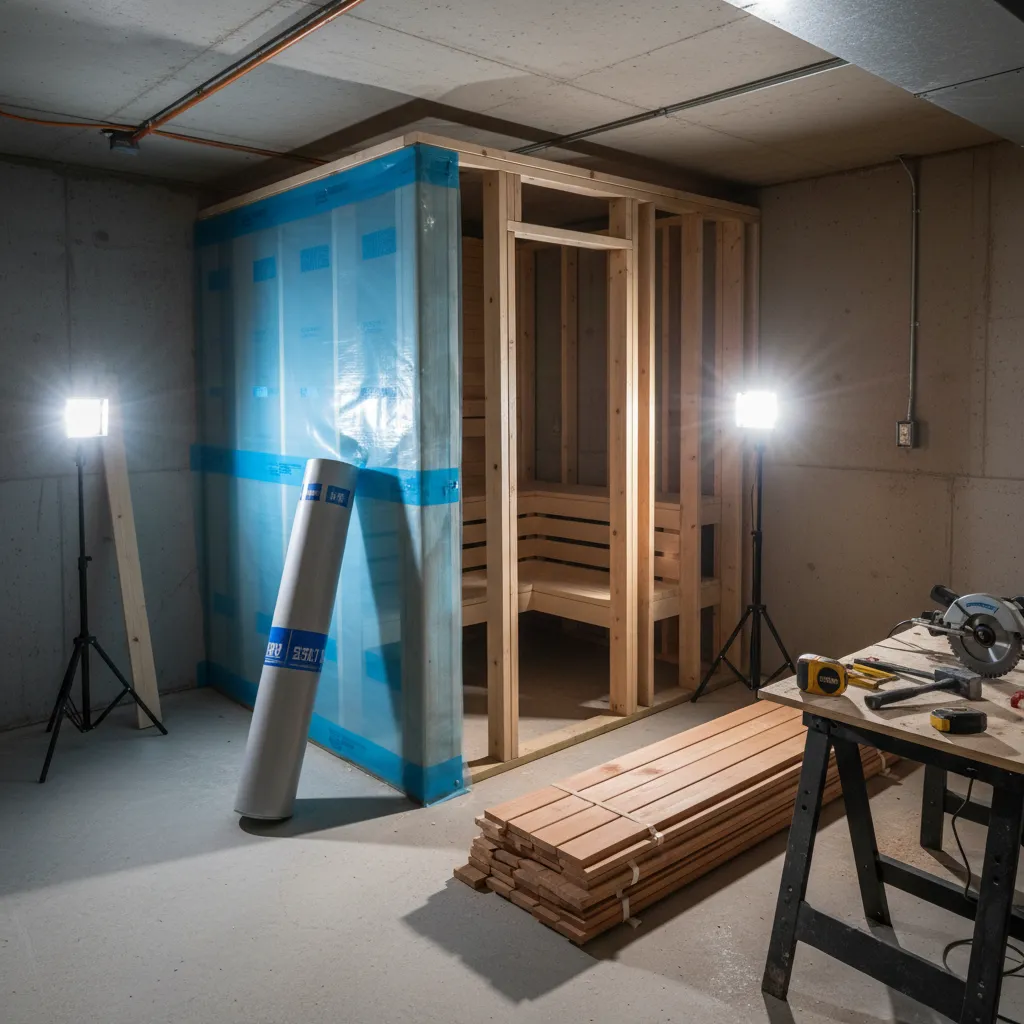
Indoor Sauna Installation Checklist: Planning to First Session
The complete indoor sauna installation checklist. Electrical, ventilation, waterproofing, permits, and the build sequence most guides skip.
Quick answer: Sauna Guide's pre-purchase rule is to price the electrical work before ordering the sauna. Plan the install as five phases over 2 to 4 weeks: pre-purchase checks, electrical, framing and insulation, interior finish, then heater hookup and inspection, at $1,600 to $9,500 on top of the sauna unit itself. The dedicated 240V circuit is the biggest surprise cost ($500 to $3,000). The two details contractors most often get wrong are the warm-side foil vapor barrier and the low intake plus high exhaust ventilation path.
Best for
Buyers about to install a traditional indoor sauna who want the full build sequence and the exact questions to ask an electrician.
Wrong fit
Infrared buyers, whose 120V plug-in units skip most of this checklist, and outdoor sauna projects.
Tradeoff
Doing the carpentry yourself saves real money, but the electrical work must be licensed and permitted, and skipping that risks failed inspections and voided insurance.
The sauna itself is the easy part. What trips people up is everything between "I bought a sauna" and "I am sitting in it."
The number one complaint on sauna forums is some version of: "Nobody told me about the electrical requirements." Followed closely by: "My contractor had never installed a sauna before and made three mistakes."
This checklist exists so that does not happen to you. It covers the full sequence. Pre-purchase planning, electrical, ventilation, waterproofing, the build itself, permits, and common mistakes. Print it out, tape it to the wall of your future sauna room, and check things off as you go.
Sauna Guide's Pre-Purchase Verdict
Phase
Key Tasks
Typical Cost
Time
Pre-purchase planning
Measure space, check electrical panel, research permits
$0 (your time)
1 - 2 weeks
Electrical
Dedicated 240V circuit, GFCI, wiring
$500 - $3,000
1 - 3 days
Framing and insulation
Stud walls, R-13+ insulation, vapor barrier
$300 - $1,500
1 - 2 days
Interior finish
Paneling, benches, door, vents
$500 - $3,000
1 - 3 days
Heater and final hookup
Mount heater, connect electrical, inspection
$300 - $2,000
1 day
Total
$1,600 - $9,500 (above sauna unit cost)
2 - 4 weeks
Do not order the sauna until an electrician has checked the panel, circuit size, wire run, and permit path against the actual heater manual. A beautiful kit with an unresolved 240V scope is a hold. A plainer kit with a written electrical plan, ventilation layout, and complete installed cost is the safer buy.
Phase 1: Pre-Purchase Checklist (Do This BEFORE You Buy)
These five checks take a few hours and can save you thousands. Do not skip them.
1. Measure Your Space
You need a minimum of 4 x 4 feet of floor space for a 1-person sauna. For two people, 4 x 6 feet is the comfortable minimum. Our home sauna size guide has detailed dimensions by capacity.
Critical measurements:
Floor dimensions (length, width)
Ceiling height (7 feet minimum, 7.5 feet ideal, never above 8 feet in sauna room)
Door swing clearance
Distance from the space to your electrical panel
Why ceiling height matters: heat stratifies. The difference between your feet and your head can be 40 degrees F. Ceilings above 8 feet waste energy heating air you will never sit in. Too low and the upper bench becomes unbearable.
2. Check Your Electrical Panel
Walk to your breaker box and answer these questions:
How many open breaker slots do you have? You need 2 slots for a 240V double-pole breaker.
What is your panel's total amperage? Most homes have 100A or 200A panels. A sauna heater draws 30 to 50A. If your panel is 100A and already near capacity, you may need a panel upgrade ($1,500 to $3,000).
How far is the panel from the sauna location? Longer wire runs cost more and may require heavier gauge wire.
This is the single biggest surprise cost. Get an electrician to assess your panel before you order a sauna. A 15-minute visit (many electricians offer free estimates) can prevent a $3,000 surprise.
3. Research Local Permits and Building Codes
Call your city or county building department. Ask:
"Do I need a permit to install a sauna in my home?"
"What electrical permits are required for a 240V, 40-amp circuit?"
"Are there any fire separation requirements for residential saunas?"
Answers vary wildly by jurisdiction. Some cities require nothing. Some require electrical permits only. Some require full building permits with plans. The phone call takes five minutes.
The insurance question: Call your homeowner's insurance provider too. Ask if a sauna installation affects your coverage or premiums. Most policies cover saunas as part of the home, but some insurers want to know about them. Better to ask now than after a claim.
4. Get an Electrician Quote First
Not after you buy. Before. Get 3 quotes. Tell them:
Heater wattage (typically 4.5 to 9 kW for home saunas)
Voltage (240V for traditional, 120V for most infrared)
Amperage (30A to 50A depending on heater)
Distance from panel to sauna location
Whether you need a panel upgrade
Typical electrician costs:
Simple run (panel nearby, no upgrade): $500 - $1,000
Moderate run (panel in basement, sauna on main floor): $1,000 - $2,000
Complex (panel upgrade needed or long run): $2,000 - $3,000+
This is the cost people miss. The home sauna cost guide covers all the hidden expenses.
5. Choose Your Sauna Type
This affects everything that follows.
Pre-built modular (kit): Freestanding panels that assemble inside an existing room. Easiest install. Walls, ceiling, benches, and door come as a package. You still need electrical and possibly ventilation. See our DIY vs kit vs pre-built guide for a full comparison.
Custom build: You frame walls, insulate, panel, and build benches from scratch. More work, more control, lower material cost. Better for odd-shaped spaces.
Infrared: Most plug into a standard 120V/20A outlet. No special ventilation needed. Minimal installation. If simplicity is your priority, infrared eliminates most of this checklist. See our infrared vs traditional comparison to decide.
Phase 2: Electrical Requirements
This is the section everyone needs. Read it even if you are hiring an electrician. You should understand what they are doing and why.
Traditional Sauna Electrical Specs
Heater Size
Voltage
Circuit Breaker
Wire Gauge (up to 50 ft)
4.5 kW
240V
30A
10 AWG
6 kW
240V
40A
8 AWG
8 kW
240V
40A
8 AWG
9 kW
240V
50A
6 AWG
Key requirements:
Dedicated circuit. The sauna heater gets its own breaker. Nothing else on that circuit. Ever.
GFCI protection. Required by code in most jurisdictions. The breaker itself is GFCI type, not a GFCI outlet.
Wire gauge matters. Undersized wire overheats. This is not a place to save money. If your run exceeds 50 feet, go up one wire gauge from the table above.
Conduit. Wiring inside the sauna room must be in conduit and rated for high temperature. Standard Romex insulation degrades above 140 degrees F. Your electrician should know this, but many general electricians have never wired a sauna.
Infrared Sauna Electrical Specs
Most infrared saunas run on 120V/20A. A standard household outlet on a 20A circuit is usually sufficient. Some larger infrared units (3 to 4 person) require 240V/30A. Check the manufacturer's spec sheet.
The big advantage: no electrician needed for most infrared installations. Plug in, turn on.
The Electrician Conversation
When you meet with electricians, ask these specific questions:
"Have you wired a sauna before?" (Preferred answer: yes.)
"What type of wiring will you use inside the sauna room?" (Should be high-temperature rated.)
"Will you pull a permit for the electrical work?" (Should be yes.)
"Will the installation pass inspection?" (They should be confident.)
Phase 3: Ventilation
Ventilation is the most overlooked part of indoor sauna installation. Skip it and you get stale air, uneven heating, and mold problems.
The Basics
Every sauna needs two openings:
Intake vent. Near the floor, close to the heater. Brings in fresh air. The heater warms this incoming air as it enters.
Exhaust vent. On the opposite wall, near the ceiling (or high on the wall). Lets hot, stale air exit.
This creates a natural convection loop. Fresh air enters low, gets heated, rises, circulates through the room, and exits high. You get even heat distribution and fresh air to breathe.
Vent Sizing
Intake: 4 to 6 inches diameter, or equivalent rectangular opening
Exhaust: Same size or slightly larger than intake
Both should have adjustable louvers so you can control airflow
Mechanical vs. Passive
Passive ventilation (just the openings, no fan) works in most residential saunas. The temperature differential between the sauna and the adjacent room creates enough draft.
Mechanical ventilation (exhaust fan) is needed if:
The sauna is in an interior room with no exterior wall
The adjacent room is small and poorly ventilated itself
You are using the sauna with high humidity (lots of water on stones)
A bathroom exhaust fan rated for high temperature works. Mount it on the exhaust vent and run it on a timer.
Phase 4: Waterproofing and Moisture Control
Saunas generate moisture. In an outdoor sauna, that moisture escapes naturally. Indoors, it will destroy your walls, ceiling, and subflooring if you do not manage it.
Vapor Barrier
Required. A foil-faced vapor barrier goes on the warm side of the insulation (facing into the sauna). This is the opposite of how vapor barriers work in standard construction, and it confuses contractors who have never built a sauna.
The barrier does two things:
Reflects radiant heat back into the sauna (improving efficiency)
Prevents moisture from migrating into the wall cavity (preventing mold and rot)
Use aluminum foil vapor barrier specifically designed for saunas. Not plastic sheeting. Not standard house wrap. Tape all seams with foil tape.
Floor
The floor sees the most moisture. Water drips off bodies, water splashes from the bucket, condensation forms when the sauna cools.
Good floor options:
Concrete (sealed)
Ceramic or porcelain tile with drain
Vinyl or composite with drain
Bad floor options:
Carpet (will grow mold)
Unsealed wood (will rot)
Laminate (will swell and delaminate)
A floor drain is ideal but not always required. If you have one, slope the floor slightly toward it (1/4 inch per foot). If no drain, use a squeegee after sessions and leave the door open to dry.
Wall and Ceiling Insulation
Location
Minimum R-Value
Recommended
Walls
R-13
R-13 to R-15
Ceiling
R-19
R-24 to R-30
Floor
R-11
R-13
Insulate the ceiling more than the walls. Heat rises. An under-insulated ceiling is the biggest source of energy waste in home saunas.
Use fiberglass batt or mineral wool insulation. Not spray foam. Spray foam can off-gas at sauna temperatures and is a fire concern.
Phase 5: Build Sequence
Order matters. Do these steps out of sequence and you will be tearing things apart to fix earlier mistakes.
Step 1: Frame and Insulate
Frame the walls with 2x4 studs at 16 inches on center. If converting an existing room, you may be adding framing inside existing walls to create an insulation cavity. Insulate between studs. Insulate the ceiling.
Step 2: Vapor Barrier
Staple foil vapor barrier over all insulated surfaces, shiny side facing into the sauna. Overlap seams by 6 inches. Seal all seams, penetrations, and edges with foil tape. This is fussy work but critical. One gap and moisture finds the wall cavity.
Step 3: Run Electrical
Run the wiring from the panel to the sauna before you close up the walls. The heater junction box location should be planned now. Leave enough slack in the wire for the final connection.
Do this before paneling. Running wire after the walls are finished means cutting holes and fishing wire through tight spaces.
Step 4: Interior Paneling
Tongue and groove wood paneling over the vapor barrier. Cedar, hemlock, aspen, or alder are the standard choices. Do not use pine (it leaks resin at sauna temperatures) or treated lumber (chemicals off-gas).
Install horizontally or vertically. Horizontal is more traditional and makes individual board replacement easier.
Step 5: Build and Install Benches
Upper bench height: 36 to 44 inches from the floor depending on ceiling height. The upper bench surface should be roughly level with the top of the heater stones. This puts you in the hottest air.
Lower bench: 18 to 20 inches from the floor. Used as a step and as a cooler seating option.
Bench depth: 24 inches minimum for sitting, 28 inches for reclining.
Step 6: Install Heater
Follow the manufacturer's clearance requirements exactly. Every heater has minimum distances from walls, ceiling, and bench surfaces. These are not suggestions. They are fire safety requirements.
Most wall-mounted heaters need 3 to 6 inches from the back wall and 5 to 8 inches from side walls. Check your specific model. Harvia and Huum publish detailed clearance diagrams.
Step 7: Install Vents
Cut openings for intake and exhaust vents. Install vent covers with adjustable louvers.
Step 8: Hang the Door
Sauna doors should open outward (safety requirement, so you can exit even if you collapse against the door). Tempered glass doors are popular because they let light in and feel less claustrophobic. A solid wood door retains more heat.
Step 9: Final Electrical Hookup and Inspection
Your electrician connects the heater, installs the control panel, and tests the system. If your jurisdiction requires an electrical inspection, schedule it now. Do not skip the inspection. It protects you and validates the work.
Common Installation Mistakes
These come up repeatedly in forums and contractor reviews. Learn from other people's mistakes.
Using the wrong insulation. Spray foam off-gasses at high temperatures. Foil-faced polyiso degrades above 180 degrees F. Use fiberglass batt or mineral wool only.
Vapor barrier on the wrong side. It goes on the warm side (facing into the sauna). Contractors who have only done standard construction instinctively put it on the cold side. Wrong. This traps moisture in the wall cavity.
Skipping the dedicated circuit. Sharing a circuit with other appliances causes voltage drops, breaker trips, and fire hazards. The sauna heater gets its own circuit. Period.
Ceiling too high. Standard 8-foot ceilings are already at the upper limit. If your room has 9 or 10-foot ceilings, build a dropped ceiling to bring it down to 7 to 7.5 feet in the sauna. Otherwise you waste enormous energy heating air above your head.
No ventilation. "I will just open the door." That is not ventilation. You need dedicated intake and exhaust openings that work while the sauna is in use with the door closed.
Pine paneling. Pine is cheap and available. It also oozes sticky resin at sauna temperatures. You will burn yourself on hot resin drops. Use cedar, hemlock, aspen, or alder.
Timeline and Cost Summary
Here is what a typical indoor sauna installation looks like for a 4 x 6 foot (2-person) custom build in an existing room.
Phase
Duration
Cost Range
Planning and quotes
1 - 2 weeks
$0
Electrical work
1 - 2 days
$500 - $2,000
Framing and insulation
1 day
$300 - $800
Vapor barrier
Half day
$50 - $150
Paneling
1 - 2 days
$400 - $1,200
Benches
1 day
$200 - $600
Heater and controls
Half day
$500 - $2,000
Door
Half day
$200 - $800
Vents
2 hours
$50 - $100
Inspection
1 day wait
$50 - $200
Total (labor and materials, excluding sauna kit)
2 - 4 weeks
$2,250 - $7,850
The table already includes the heater and controls. Add the sauna kit or the remaining shell materials, typically $1,500 to $8,000, on top. For a comprehensive budget breakdown, see the home sauna cost guide.
Frequently Asked Questions
Do you need a permit for a home sauna?
It depends on your local building codes. Electrical work almost always requires a permit. Structural modifications (adding walls, cutting openings) often do too. Some jurisdictions require permits for any room where the temperature exceeds a certain threshold. Call your building department. Five-minute phone call, potentially thousands of dollars in fines avoided.
How much does it cost to install a sauna?
For a pre-built modular kit in an existing room with simple electrical: $2,000 to $5,000 total including the unit. For a custom-built sauna from scratch: $5,000 to $15,000 depending on size, heater, and electrical complexity. The biggest variable is electrical work. The cost guide breaks this down in detail.
Can you put a sauna in a bathroom?
Yes, and it is one of the best locations. Bathrooms already have moisture-resistant construction, floor drains, ventilation fans, and proximity to showers. You still need the vapor barrier, proper insulation, and a dedicated electrical circuit. But you save on waterproofing and drainage work.
Do you need special wiring for a sauna?
Yes. Traditional saunas need a dedicated 240V circuit with a GFCI breaker. The wire inside the sauna room must be high-temperature rated and run in conduit. Standard residential wiring (Romex) degrades at sauna temperatures. This is not a DIY electrical project unless you are a licensed electrician.
Can I install a sauna myself?
The carpentry, yes, if you have basic framing and finishing skills. The electrical, no, unless you are licensed. Electrical permits require licensed work in most jurisdictions, and insurance may not cover damage from unpermitted electrical installations. Budget for a licensed electrician even if you do everything else yourself.
Sources
National Electrical Code (NEC) Article 680 and residential sauna provisions
International Residential Code (IRC) Section R303 ventilation requirements
Harvia heater installation manuals and clearance specifications
Huum heater installation documentation
Finnish Sauna Society construction standards
Before You Start: Get the Cost and Compliance Right
The two parts of this checklist that blow up budgets are electrical and permits. Both are knowable before you buy:
Already holding a kit or contractor quote? Send it through Sauna Guide's free quote review. We check the electrical scope, ventilation, heater sizing, site work, delivery terms, and exclusions before you sign.
These guides are built from manufacturer documentation, public specifications, primary research where health claims matter, and repeated buyer questions that show up in real ownership and installation decisions.
Manufacturer responses can clarify pricing bands, warranty terms, support footprint, or common mistakes. They do not move a page up the shortlist on their own.