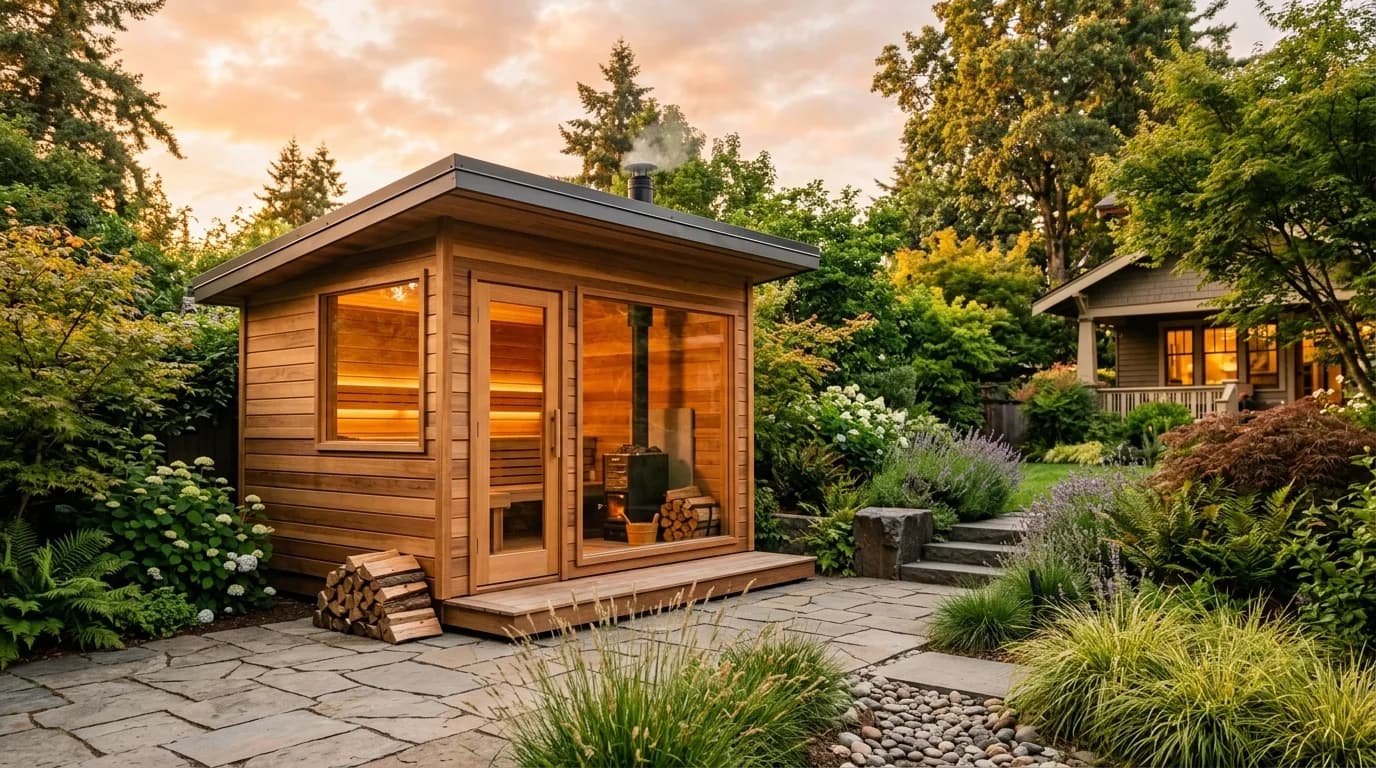
Best Sauna for Backyard (2026): What Holds Up Year After Year
The best backyard sauna options for 2026. Picks across barrel, cabin, and pod styles, plus the foundation, power, and weather decisions that actually matter.
Quick answer: The best backyard sauna is the one matched to your foundation, your power access, and your climate, not the one with the best photo. A traditional outdoor cabin or barrel on a proper pad with a real heater is the durable default. The decisions that make or break a backyard sauna are the pad and the power run, not the cabin itself.
Best for
Homeowners with yard space who want a permanent outdoor sauna and are willing to do the foundation and power work properly.
Wrong fit
Buyers with no path to power and no interest in wood-fired, or anyone expecting a backyard sauna to need no site prep.
Tradeoff
A backyard sauna gives you the best version of the experience with no moisture risk to the house, but it pushes all the difficulty into site work: foundation, power, drainage, and weather. Skip that work and the cabin disappoints no matter how good it is.
A backyard is the best place to put a sauna. Outside, the heat and steam belong to the outdoors, there is no moisture risk to your house, and the cool-down walk in fresh air is the part owners love most.
The trap is thinking the decision is "which cabin." It is not. A backyard sauna lives or dies on the pad it sits on and the power that reaches it. Get those right and almost any quality cabin works. Get them wrong and the best cabin on the market still disappoints.
Quick comparison: backyard sauna styles
Style
Footprint
Heat
Power need
Best for
Barrel sauna
Compact, ~6 ft diameter
Traditional electric or wood
240V or none (wood)
Fast heat-up, value, classic look
Outdoor cabin
Medium to large
Traditional electric or wood
240V or none (wood)
More room, benches, the full build
Outdoor infrared cabin
Small to medium
Infrared
120V or 240V by model
Buyers who want low-moisture, simpler heat
Pod / modern kit
Medium
Traditional electric or wood
240V or none (wood)
Design-led yards, turnkey look
Barrel: the value default
A barrel sauna is the most common backyard starting point for good reason. The curved shape has less air volume to heat, so it warms up fast and runs efficiently. They are widely available, look the part, and sit at the lower end of the price range.
The tradeoffs: barrels seat fewer people than the footprint suggests, the curved benches are not to everyone's taste, and a thin, cheap barrel will not hold heat in a real winter. If you are comparing a barrel against a boxy cabin, the sweat tent vs barrel sauna and best outdoor sauna brands guides go deeper.
Outdoor cabin: more room, the full experience
A cabin-style outdoor sauna gives you flat walls, proper bench tiers, and room for two to six people. It is the closest backyard equivalent to a built-in sauna. Quality outdoor cabins come from Almost Heaven Saunas, Redwood Outdoors, and Nootka Saunas, among others.
The tradeoff is cost and footprint. A cabin needs a bigger, more level pad and usually a more serious heater and power run than a compact barrel.
Outdoor infrared: lower moisture, simpler heat
An outdoor infrared cabin trades the steam experience for low moisture and, on smaller models, a 120V outlet instead of a 240V circuit. It is the simpler backyard build. The tradeoff is the familiar one: infrared is a different, gentler heat than traditional löyly. See infrared vs traditional sauna.
Before you buy: the backyard site checklist
1. Solve the foundation first
This is the decision that matters most. A backyard sauna needs a level, stable, well-draining pad: a concrete slab, a gravel base, or proper piers. A sauna set on bare ground or an unlevel patio will twist, hold water, and rot at the base. The outdoor sauna foundation guide walks through the options.
2. Plan the power run honestly
For a traditional electric heater, a 240V dedicated circuit has to reach the sauna. An underground run from the house panel to a detached structure across a yard is real money, often $1,500 to $4,000 depending on distance and trenching. Price this before you choose the cabin. The sauna electrical planning guide covers it. If a power run is impractical, a wood-fired heater removes the problem entirely, covered in outdoor sauna with no electricity.
3. Build for your actual winter
A backyard sauna in a cold climate needs insulation and a heater sized for outdoor use, or it will never reach temperature on the coldest nights you most want it. See best sauna for cold climate and outdoor sauna winter prep.
4. Check setbacks, HOA, and permits
Detached outdoor structures often have property-line setbacks, height limits, and HOA rules. Electrical and sometimes structural permits are common. One call to the building department now is far cheaper than moving a finished sauna later.
5. Plan drainage and the path
Decide where rinse water goes and make sure the walk from the house to the sauna works in winter, in the dark, barefoot. The cool-down walk is part of the experience, so it should not be a hazard.
Common mistakes that cost backyard sauna owners money
Skipping the foundation. A sauna on an unlevel or wet base will rack, hold water, and rot. This is the single most expensive backyard mistake.
Not pricing the power run. Buyers budget for the cabin and discover the 240V trench to a detached structure costs as much again. Price it before you buy.
Buying for mild weather, using in winter. A thin cabin that works in October fails in January, which is exactly when you want it most.
Ignoring setbacks and HOA. A finished sauna over a property-line setback is a relocation project, not a sauna.
What it actually costs
Component
Barrel route
Cabin route
Sauna kit
$5,400-$11,700
$6,100-$14,400
Foundation pad
$400-$2,500
$800-$3,500
Electrical run + circuit
$1,200-$4,000
$1,500-$4,500
Heater (if not included)
$0-$1,500
$0-$2,000
Permits / inspection
$100-$600
$150-$800
Total realistic range
$7,100-$20,300
$8,550-$25,200
Wood-fired removes the electrical run but adds a chimney and tending. For the full breakdown, see the home sauna cost guide for 2026.
Plain recommendation
If you want the best value backyard sauna, start with a quality barrel on a proper gravel or slab pad, with a heater sized for outdoor winter use.
If you want more room and the full cabin experience and your budget allows, an outdoor cabin from a credible maker is the better long-term sauna.
Either way, spend on the foundation and price the power run before you fall in love with a cabin. Those two decisions, not the model, are what make a backyard sauna last.
FAQ
What is the best type of sauna for a backyard?
For most buyers, a traditional outdoor barrel or cabin on a proper foundation, with an electric or wood-fired heater. Barrels win on value and heat-up speed. Cabins win on space and the full experience. Outdoor infrared is the lower-moisture, simpler-power alternative.
Does a backyard sauna need a concrete foundation?
It needs a level, stable, well-draining base. That can be a concrete slab, a compacted gravel pad, or proper piers depending on the sauna and your soil. What it cannot sit on is bare ground or an unlevel patio. See the outdoor sauna foundation guide.
How much does it cost to run power to a backyard sauna?
An underground 240V run from the house panel to a detached sauna typically costs $1,500 to $4,000 depending on distance and trenching. This is often the most underestimated line in a backyard sauna budget. A wood-fired heater avoids it entirely.
Can a backyard sauna handle winter?
Yes, if it is built for it. That means adequate insulation and a heater sized for outdoor use in your climate. A thin warm-weather cabin will not reach temperature on the coldest nights, which are exactly when you want the sauna. See best sauna for cold climate.
What permits do I need for an outdoor sauna in my backyard?
Often a building permit for the detached structure plus an electrical permit for the circuit, and frequently a zoning/setback review. Detached outdoor structures commonly have setback, height, and lot-coverage rules on top of the electrical inspection. Call your local building department before you build. It is the cheapest insurance in the whole project. Full breakdown: sauna permit requirements in the US.
Can my HOA stop me from putting a sauna in my backyard?
Yes, it can. An HOA's architectural review is separate from any government permit and can restrict placement or appearance, or refuse a fully legal, fully permitted structure outright. If you have an HOA, send the architectural-review request in parallel with the building department, never after. People lose deposits discovering this in the wrong order.
These guides are built from manufacturer documentation, public specifications, primary research where health claims matter, and repeated buyer questions that show up in real ownership and installation decisions.
Manufacturer responses can clarify pricing bands, warranty terms, support footprint, or common mistakes. They do not move a page up the shortlist on their own.