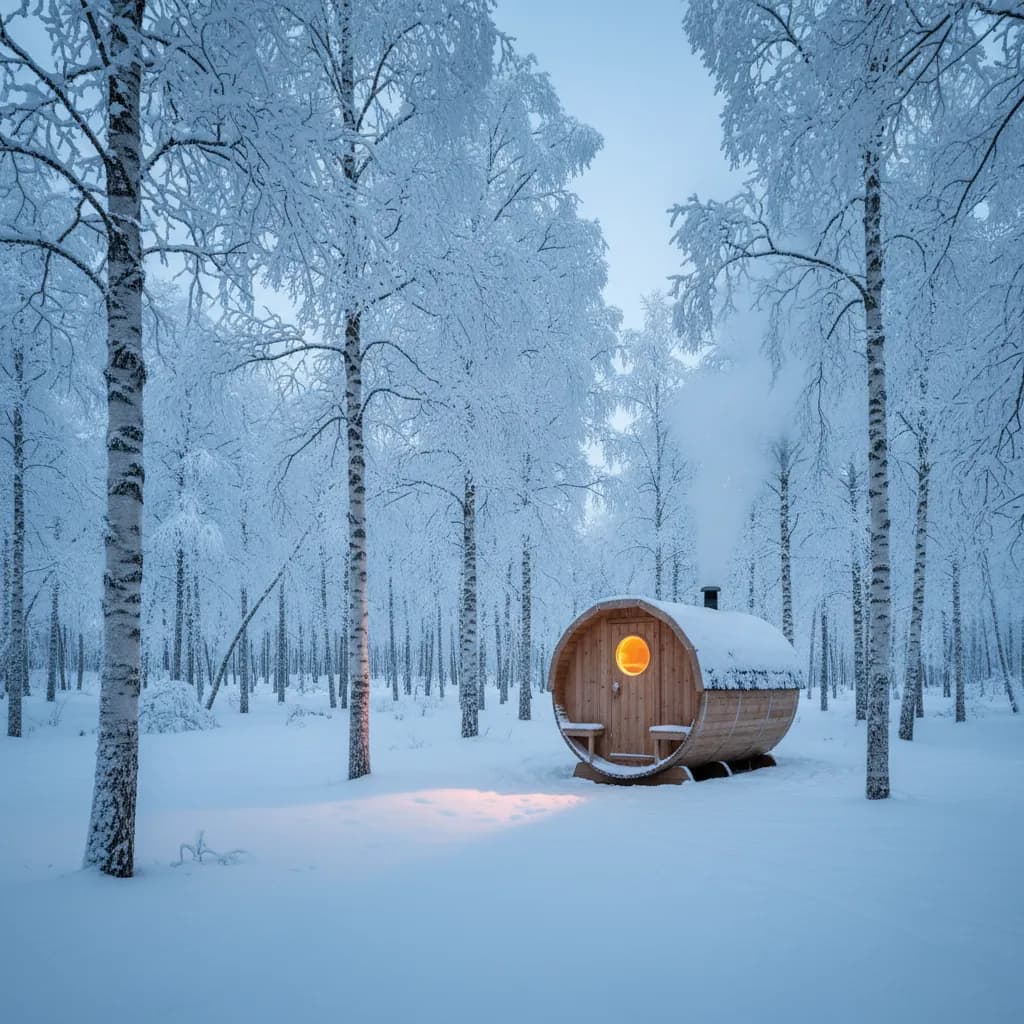
Best Sauna for Cold Climate (2026): What Holds Up in Winter
Compare insulated cabins, solid-timber kits, and barrels for cold climates. Check wall construction, heater sizing, warm-up time, and foundation risk.
Sauna Type
Quick answer: For regular winter use, choose an insulated framed or panel cabin with a documented wall assembly and a heater sized from the room's effective volume. A solid-timber cabin or barrel can still work, but wall thickness is not insulation and winter warm-up will depend more on wind, glass, air leakage, and the exact heater.
Best for
North American buyers planning regular sauna use through freezing winters.
Wrong fit
Mild-climate buyers who do not need to pay extra for documented winter construction.
Tradeoff
An insulated cabin costs more and takes more site planning. A simpler solid-wood kit costs less, but leaves less margin for heater sizing, air leakage, and long cold starts.
The safest cold-climate buy is not the sauna with the thickest-looking wood. It is the one whose seller can document the wall and ceiling assembly, the exact heater model, and the base requirements before you pay.
For regular winter use, start with an insulated framed or panel cabin. If easy access and low maintenance matter most, putting the sauna inside the house or a properly prepared garage is usually more practical than crossing an icy yard. A barrel can still work, but it is the compromise route, not the default winter winner.
Quick recommendation by buyer
Your situation
Best starting point
Why
Main catch
Hard winter, regular outdoor use
Insulated panel or framed cabin
The wall assembly reduces heat loss and gives the heater more margin
Higher purchase and site cost
Hard winter, convenience first
Indoor sauna or properly prepared garage install
Shorter walk, protected exterior, and less weather exposure
The room still needs correct ventilation and electrical work
Moderate winter, tighter budget
Solid-timber cabin
Simpler kit and several heater choices
Thick lumber is not the same as an insulated wall
Barrel look is non-negotiable
Small barrel with a roof package and correctly sized heater
Lower room volume and simpler assembly
No published R-value on most models, more variable winter warm-up
Remote site without a practical 240V run
Code-compliant wood-fired cabin
Avoids a long electrical run
Chimney, clearances, permits, firewood, and insurance become part of the project
What we checked
We reviewed the exact-query search results and current manufacturer pages on August 18, 2026. The repeated advice was cabin over barrel, more insulation, and more heater power. The problem was proof. Several pages gave universal temperature cutoffs or told every outdoor buyer to add 20 to 50 percent heater capacity without linking to a heater manual.
Our comparison uses published construction and heater data instead:
the wall or panel assembly the manufacturer actually describes
the exact heater output supplied or offered
glass, floor, roof, exterior-finish, and foundation details
whether a winter performance claim is documented or still needs written confirmation
We have not personally cold-chamber tested these saunas. A manufacturer specification is evidence of what is supplied, not proof of how fast the room will heat at your address.
Canadian Thermowood, shingles, tempered-glass door
6 kW standard with 8 kW and 9 kW upgrade paths
No published wall R-value or model-specific winter heat-up result
Custom framed cabin
Finlandia specifies R-13 for 2 x 4 framing or R-19 for 2 x 6 framing, plus a foil vapor barrier
Heater selected from effective room volume
More contractor work and no single-kit price
These are not five equivalent products. They show the construction choices a winter buyer is actually making.
Best documented insulated route: Finlandia outdoor prefab
Finlandia publishes the clearest wall assembly in this group. Its prefabricated room uses framed panels with R-11 fiberglass, a foil vapor barrier, interior paneling, and an exterior skin. The outdoor package adds the roof and weather-specific hardware. That documentation matters more than a vague claim such as "built for winter."
For a custom framed room, Finlandia lists R-13 insulation in 2 x 4 walls and R-19 in 2 x 6 walls. Treat those figures as Finlandia's construction specification, not as a universal code requirement. Your local code, climate zone, and wall design still govern the final assembly.
Best for: buyers who want an outdoor traditional sauna and care more about a documented envelope than a one-click checkout.
Watch for: dealer pricing, final heater selection, roof assembly, delivery, and the contractor scope are separate decisions.
Best dealer-led package: Finnleo NorthStar Outdoor
Finnleo publishes more installation detail than most kit sellers. The NorthStar Outdoor includes panelized walls, an integral waterproof vinyl floor, a metal roof, insulated sidelite glass, and app-capable controls. The 4 x 6 pairs with a 4.5 kW heater. The 5 x 6 and 5 x 7 pair with 6.0 kW heaters.
The NorthStar installation manual requires a solid, flat, level base that supports the full loaded room. It recommends a properly designed concrete pad or equivalent platform and tells the installer to follow local anchoring and electrical rules.
Best for: buyers who want one dealer to own more of the room, heater, control, and installation conversation.
Watch for: Finnleo does not publish the panel R-value or a low-ambient heat-up table on the product page. Ask for both in writing if those details decide the purchase.
Best solid-timber value route: Almost Heaven Allegheny
Almost Heaven's Allegheny shows why "cabin" does not automatically mean "insulated." Its official page lists 1.5-inch Nordic spruce walls, an 8 kW standard electric heater, a 10.5 kW electric upgrade, and a wood-fired option. It does not publish an insulated wall assembly or R-value.
That does not make it a bad sauna. It makes it a solid-timber cabin, which should be compared honestly with an insulated panel cabin. Almost Heaven says its saunas typically reach 165 degrees F in 30 to 40 minutes and 185 degrees F in under 60 minutes, while also warning that outdoor winter ambient temperature increases warm-up time. That is a brand-level expectation, not a guarantee for every model or climate.
Best for: buyers who want a traditional cabin format and are willing to confirm winter performance for the exact heater and location.
Watch for: do not translate 1.5 inches of solid wood into an invented insulation value.
When a barrel still makes sense
A barrel is reasonable when budget, assembly speed, and appearance matter more than predictable heat retention. Keep the room small, buy the roof or shingle package, and choose the heater from the manufacturer's room range after accounting for glass and uninsulated surfaces.
Redwood Outdoors currently pairs its 6-person Thermowood barrel with a 6 kW heater and offers 8 kW and 9 kW alternatives. That does not mean the largest heater is automatically correct. It means the buyer has a sizing conversation to finish before ordering.
Choose a barrel only if you accept these tradeoffs:
the solid wall usually has no published R-value
opening the door replaces a larger share of the room's warm air
lower bench and foot temperatures can be more noticeable
heat-up time is more sensitive to ambient temperature, wind, glass, and air leakage
a roof package and exterior finish are part of the product, not optional decoration
Size the heater from effective volume, not the person count
"Seats six" is not a heater calculation.
Harvia's current sizing guidance starts at about 1 kW per cubic meter of sauna volume. It then adds the equivalent of 1.2 cubic meters for every square meter of glass, stone, or similar uninsulated surface. For non-insulated log walls, Harvia uses a factor of 1.5.
HUUM's sizing method follows the same logic, with an additional cubic meter for each square meter of uninsulated glass, brick, or tile.
That leads to a better buying rule:
Measure the real interior length, width, and ceiling height.
Add the glass door and window area.
Classify the wall as insulated, solid log, or otherwise uninsulated.
Run those numbers through the exact heater manufacturer's chart.
Confirm voltage, amperage, breaker, wire, clearances, and controller with the dealer and electrician.
Do not add a generic percentage just because the sauna sits outdoors. The heater must remain inside the room-volume range published for that exact model. Our heater size calculator applies Harvia's glass adjustment, labels its separate uninsulated-wall safety adjustment, and shows the electrical load to verify.
Ask for a winter warm-up answer in writing
Warm-up time is a system result. It changes with:
starting air temperature
wind exposure and air leakage
wall and ceiling assembly
glass area
room volume and ceiling height
heater output and stone load
how often the door opens
Ask the seller this exact question:
For this room, heater, voltage, and glass package, what warm-up time should I expect at my normal winter low, and is that expectation covered by your sizing recommendation?
If the seller answers only with a summer marketing number, the winter performance is still unverified.
Freeze-thaw planning is a foundation decision
The sauna kit does not decide the foundation. Soil, drainage, frost depth, wind, snow load, local code, and the weight of the assembled room do.
Before ordering:
get the manufacturer's loaded weight and full base footprint
confirm whether the warranty allows gravel, pavers, deck, or requires a slab
keep surface water and snowmelt moving away from the base
ask the local permit office or engineer how frost depth changes footings, slab edges, piers, and anchoring
ask for a published roof snow-load rating instead of assuming a pitched or curved roof is enough
finish exposed exterior wood exactly as the manual requires
Finnleo recommends a concrete pad or equivalent full-support platform and local-code anchoring. Almost Heaven accepts several base types but still requires a flat, level, well-drained site. The outdoor sauna foundation guide covers the site options, but the final design belongs to your local conditions.
The seven questions to send every seller
What is the complete wall and ceiling assembly, including insulation and vapor control?
What R-value do you publish for the assembled wall and ceiling?
What exact heater model is included, and what is its rated effective room-volume range?
How did you adjust for the glass door, windows, and solid or uninsulated surfaces?
What warm-up time do you expect at my normal winter low?
What base, anchoring, exterior finish, and roof snow load does the warranty require?
Who handles service if the room heats poorly after it is installed to your written specification?
If a seller cannot answer questions 1 through 4, the winter claim is marketing, not a specification.
FAQ
Any cold weather users of barrel saunas out there?
Yes, and owner reports vary widely. That is exactly why one anecdote should not decide the purchase. Room size, wall tightness, heater output, glass, wind, and bench layout change the result. Use owner reports to identify questions, then use the model's manual and heater chart to make the decision.
How big of a heater would be optimal for say a 7' x 8'?
The missing measurements are ceiling height, glass area, wall construction, and voltage. Calculate the real room volume first, add the manufacturer's allowance for glass and uninsulated surfaces, then choose a heater whose published room range includes that effective volume. A licensed electrician must verify the final circuit.
Indoor or outdoor: what are the actual practical differences?
In a cold climate, indoor usually wins on convenience and weather protection. Outdoor gives you the backyard ritual but adds the base, drainage, exterior finish, roof, wind exposure, snow, and a longer electrical run. If the outdoor sauna will be used three or four times a week, pay for a documented envelope. If convenience is what will make you use it, keep it closer to the house.
Do I need an electrician and what will it cost?
For a traditional electric heater, yes. The exact cost depends on heater kW, panel capacity, trench or conduit length, permits, and whether the service needs an upgrade. Our current canonical range is $600 to $1,800 for a dedicated 240V circuit, plus $1,500 to $3,000 only when a panel or service upgrade is actually required. Read the electrical planning guide before ordering the heater.
These guides are built from manufacturer documentation, public specifications, primary research where health claims matter, and repeated buyer questions that show up in real ownership and installation decisions.
Manufacturer responses can clarify pricing bands, warranty terms, support footprint, or common mistakes. They do not move a page up the shortlist on their own.