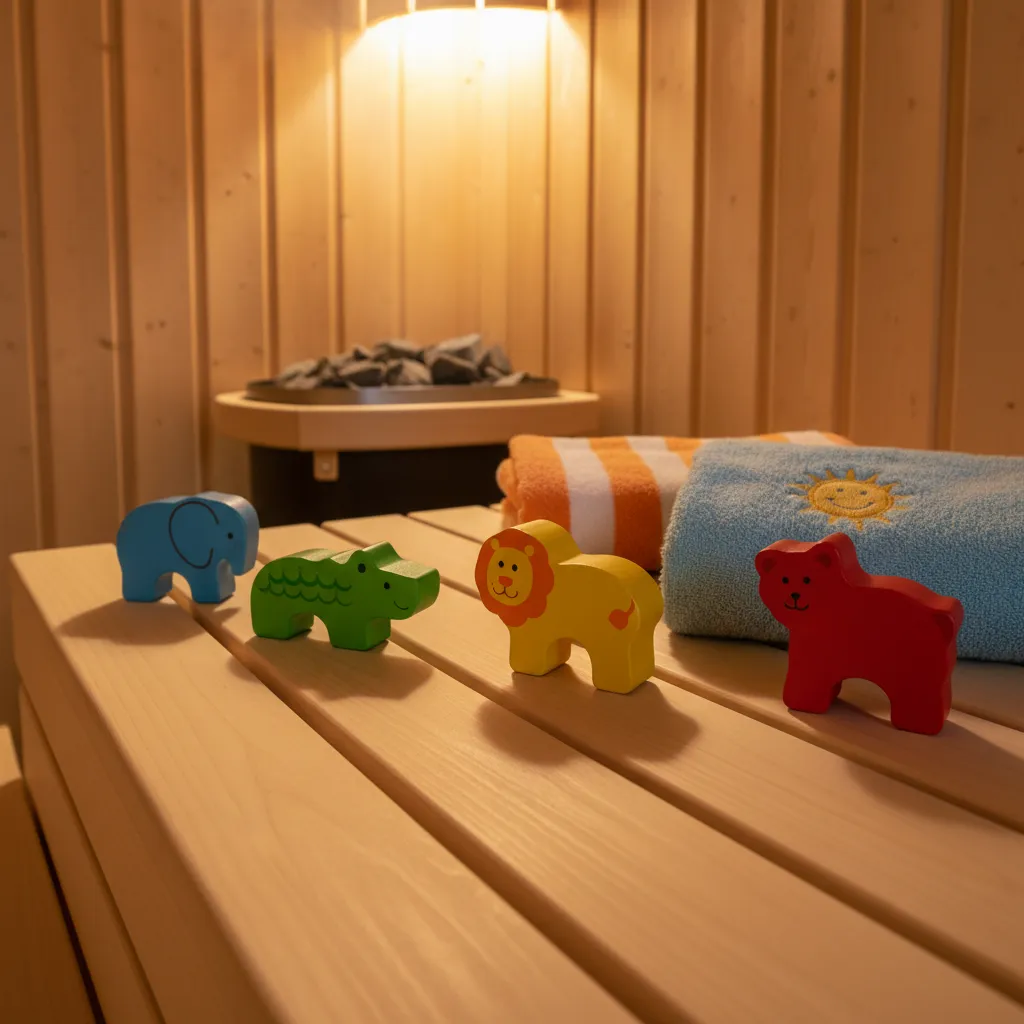
Sauna for Kids: Age-by-Age Safety Guide for Children
Is sauna safe for kids? Finnish children start as babies. Here's an age-by-age guide to sauna safety for children, from infants to teens.
Quick answer: Sauna is safe for healthy children when temperature, time, and supervision match their age. Finnish families introduce babies from 2 to 3 months old, and studies of Finnish and German children found no adverse effects with age-appropriate exposure. Keep the temperature at or below 150 F on the lowest bench for children under 9, with 5-minute maximums for babies scaling up to 15 to 20 minutes for teens. Kids overheat faster than adults because they sweat less efficiently, so the adult is the thermostat, and a child who wants out goes out immediately.
Best for
Parents who want age-by-age temperature, duration, and supervision rules for taking children into a sauna.
Wrong fit
Parents of babies under 2 months, sick or feverish children, or kids with heart or chronic conditions not cleared by a pediatrician.
Tradeoff
Starting kids early builds a family ritual the Finnish way, but it only works on the child's terms, since forcing sessions creates both safety risk and lifelong aversion.
In Finland, children go to the sauna before they can walk. Newborns as young as two to three months old are brought into the sauna by their parents. It is not considered extreme. It is considered normal. The sauna is where families spend time together, where kids learn to sit still, and where bedtime routines begin.
Outside of Finland, the idea of bringing a child into a hot room makes parents nervous. And that is fair. The sauna is hot. Kids are small. The concern makes sense.
But here is the thing: Finnish children have been doing this for centuries, and the research supports that sauna use is safe for healthy children when done with common sense and age-appropriate adjustments.
This guide walks you through exactly how to do it right.
MEDICAL DISCLAIMER: This guide provides general health information. It is not medical advice. Always consult your pediatrician before introducing your child to sauna use, especially if your child has any health conditions.
TL;DR: Quick Reference by Age
Age Group
Max Time
Max Temperature
Bench Position
Supervision
0-1 year
5 min
150°F / 65°C
Lowest, in parent's arms
Constant, skin-to-skin
1-3 years
5-10 min
150°F / 65°C
Lowest bench
Constant, within arm's reach
4-8 years
10-15 min
150°F / 65°C
Lower bench
Present in sauna
9-12 years
15-20 min
165°F / 75°C
Lower to middle bench
Present or nearby
13+ years
15-20 min
175°F / 80°C
Any bench
Can be independent if trained
These are maximums, not targets. Shorter is always fine.
Why Children Overheat Faster Than Adults
Before getting into the age-specific guidelines, it helps to understand why kids need different rules.
Children are not small adults. Their bodies handle heat differently in a few important ways:
Higher surface-area-to-body-mass ratio. A child's skin surface is large relative to their body weight. This means they absorb heat from the environment faster than an adult does. A five-year-old in a 170°F sauna is absorbing proportionally more heat than you are.
Less efficient sweating. Children's sweat glands are not fully developed until puberty. Sweating is the body's main cooling mechanism, so kids have less ability to cool themselves down once they start getting hot.
Faster heart rate response. A child's cardiovascular system responds more aggressively to heat stress. Their heart rate climbs faster and higher relative to their baseline.
Less body awareness. Young children may not recognize or communicate that they are feeling too hot until they are already uncomfortable or showing signs of overheating.
This does not mean sauna is dangerous for kids. It means you need to be the thermostat. Lower temperatures, shorter sessions, and close attention.
Age-by-Age Guidelines
Babies (0-12 months)
Finnish families typically introduce babies to the sauna between two and three months of age. The key word here is "introduce." This is not a full sauna session. It is a brief, gentle exposure.
How to do it:
Hold your baby against your body on the lowest bench
Keep the temperature mild, around 150°F / 65°C or lower
Stay for no more than three to five minutes
Watch for flushed skin, fussiness, or rapid breathing
Exit immediately if anything seems off
Have lukewarm water ready for gentle cooling afterward
Important: Never bring a newborn under two months old into the sauna. Their temperature regulation is too immature. And never bring a sick baby into the sauna.
Toddlers (1-3 years)
At this age, kids start to enjoy the sauna as a sensory experience. The warmth, the smell of wood, the sound of water on stones. Some toddlers love it. Some want nothing to do with it. Both are fine.
How to do it:
Sit together on the lowest bench
Keep sessions to five to ten minutes
Temperature should stay at or below 150°F / 65°C
Bring a cup of water for them to sip
Let them leave when they want to leave. This is not negotiable.
A cool (not cold) shower or rinse afterward
The golden rule for toddlers: If they want out, you go out. Forcing a toddler to stay in the sauna is how you create a child who hates saunas forever.
Children (4-8 years)
This is the age where sauna can become a genuine family ritual. Kids old enough to sit on the bench, understand basic instructions, and tell you how they feel.
How to do it:
Ten to fifteen minutes on the lower bench
Temperature up to 150°F / 65°C
Teach them the basics: "If you feel dizzy or weird, tell me and we leave"
Bring a small toy or tell stories to make it fun
Offer water before, during, and after
Cool down with a shower or a gentle dip in a pool
This is a good age to start teaching body awareness. Ask them: "How does your skin feel? Are you comfortable? Do you want to stay or go?" These are skills that serve them well for the rest of their sauna lives.
Older Kids (9-12 years)
By now, most kids who have grown up with sauna are comfortable and know the routine. Their bodies are also more capable of handling heat, though still not at adult levels.
How to do it:
Fifteen to twenty minutes is fine for experienced kids
Temperature can be a bit higher, up to 165°F / 75°C
They can sit on the middle bench if comfortable
They should be drinking water on their own
Teach them about sauna safety basics the way you would teach them about swimming safety
Teens (13+)
Teenagers can handle sauna sessions similar to adults, though starting conservatively is still smart. Their thermoregulation is approaching adult levels, especially post-puberty.
How to do it:
Fifteen to twenty minutes initially, building to adult session lengths
Remind them that sauna is not a competition. Sitting longer or hotter is not tougher.
Making Sauna Fun for Kids
The fastest way to ruin sauna for a child is to make it feel like a chore or a medical treatment. The fastest way to build a lifelong practice is to make it feel like something they look forward to.
For young kids:
Bring a small waterproof toy
Tell stories or sing songs
Let them pour a small ladle of water on the stones (supervised)
Make the cool-down part of the fun. Splashing, gentle hosing, rolling in snow if you are in Finland
For older kids:
Make it family time. No phones, no distractions, just conversation
Let them control the session. "You tell us when you are ready to go"
Pair it with something they love. Sauna before movie night. Sauna before hot chocolate.
In Finland, Saturday sauna is a tradition. Kids grow up looking forward to it the way other kids look forward to pizza night.
What not to do:
Never force a child to stay in the sauna
Never make it a dare or competition
Never leave a young child unattended
Never use the sauna as a punishment or reward
Warning Signs to Watch For
Children may not tell you they are overheating. You need to watch for these signs:
Flushed, red skin beyond normal pinkness
Irritability or crying that was not there before
Lethargy or unusual quietness in a normally active child
Rapid breathing or panting
Dizziness or unsteadiness when standing
Nausea or complaints of feeling sick
Hot, dry skin (this means sweating has stopped, which is serious)
If you see any of these, leave the sauna immediately. Move to a cool area. Offer water. If symptoms do not improve within a few minutes, seek medical attention.
For a deeper look at heat-related warning signs, read our sauna safety guide.
When to Skip the Sauna Entirely
Do not bring your child to the sauna if they have:
A fever. Their body is already overheated. Adding external heat is dangerous.
A stomach bug or vomiting. Dehydration risk is too high.
Sunburn. Heat on burned skin is painful and counterproductive.
Any acute illness. Let them recover first.
A heart condition or other chronic condition. Talk to their doctor first.
And the simplest rule of all: if your child does not want to go, do not make them go. Sauna should always be a choice.
The Finnish Perspective vs. Western Medical Caution
There is a genuine cultural gap here. In Finland, where there are 3.3 million saunas for 5.5 million people, sauna for children is not controversial. It is part of life. Finnish pediatricians generally support sauna use for healthy children with sensible precautions.
In the United States, the American Academy of Pediatrics does not have a formal position on children and sauna use. Many Western pediatricians default to caution and recommend waiting until age six or older. This is not necessarily based on evidence of harm. It is based on the absence of large-scale studies and a general "better safe than sorry" approach.
The research that does exist is reassuring. A Finnish study published in the European Journal of Pediatrics found no adverse health effects in children who used saunas regularly from infancy. A German study of children in traditional saunas found that healthy children tolerated sauna well with appropriate supervision and duration limits.
The bottom line: sauna is safe for healthy children when you follow age-appropriate guidelines. But if you are not sure, or if your child has any health conditions, ask your pediatrician. That conversation takes five minutes and gives you peace of mind.
Hydration: Even More Important for Kids
Children dehydrate faster than adults. Their smaller bodies have less fluid reserve, and they may not feel thirsty until they are already somewhat dehydrated.
Before sauna: Have your child drink a full glass of water in the 30 minutes before the session.
During sauna: Bring water into the sauna. Offer it every few minutes, especially for younger kids who will not ask for it themselves.
After sauna: Another full glass of water. If they have been in for longer sessions, a snack with electrolytes (a banana, some watermelon, a small sports drink) helps too.
In Finland, babies as young as two to three months old are brought into the sauna. Most Western guidelines suggest waiting until at least age two, and some recommend age six. For healthy children with no medical conditions, gentle sauna exposure from a few months old appears safe based on Finnish research and cultural practice. Start brief, stay cool, and always supervise.
How long can a child stay in a sauna?
It depends on age. Babies should stay under five minutes. Toddlers five to ten minutes. Children aged four to eight can do ten to fifteen minutes. Older kids and teens can handle fifteen to twenty minutes. These are maximums. If your child wants to leave sooner, leave sooner.
Is sauna safe for babies?
Yes, with significant precautions. Hold them in your arms on the lowest bench. Keep the temperature below 150°F / 65°C. Stay under five minutes. Watch closely for any signs of discomfort. Never bring a baby under two months old or a sick baby into the sauna.
Can sauna help children sleep better?
Many parents report that a gentle evening sauna session helps their children wind down and sleep more deeply. The mechanism is the same as for adults: the post-sauna body temperature drop signals the body to prepare for sleep. This is anecdotal, but it is consistent with what we know about thermoregulation and sleep.
Should I use a traditional sauna or infrared sauna for my child?
Either can work. Traditional saunas give you more control over humidity through steam. Infrared saunas operate at lower air temperatures, which some parents find more comfortable for children. The key factors are the same regardless of type: moderate temperature, short duration, close supervision.
Sources
Jokinen, E., et al. "Children in Sauna: Hormonal Adjustments to Intensive Short Thermal Stress." European Journal of Pediatrics, vol. 150, 1991, pp. 824-827. Study of Finnish children's physiological responses to sauna, finding no adverse effects with age-appropriate exposure.
Rissmann, A., et al. "Sauna Visits of Children in Germany." Klinische Padiatrie, vol. 214, no. 4, 2002, pp. 196-199. German study confirming safe tolerance of traditional sauna in healthy children with supervised sessions.
Finnish Sauna Society (Suomen Saunaseura), "Children and Sauna." Cultural guidelines for introducing children to sauna practice, including age-appropriate temperatures and durations.
Hannuksela, M.L., and Ellahham, S. "Benefits and Risks of Sauna Bathing." The American Journal of Medicine, vol. 110, no. 2, 2001, pp. 118-126. Review of sauna safety across age groups, including thermoregulation differences in children.
Final Thoughts
Sauna does not have to be an adults-only activity. In Finland, it never was. The sauna is where families gather, where children learn stillness, and where the rhythm of the week finds its anchor.
Start gently. Follow your child's cues. Keep it fun. And remember that the goal is not to build heat tolerance. The goal is to share something good with the people you love most.
If you are new to sauna yourself, start with our beginner's guide to get your own practice dialed in first.
Thinking about a home sauna? Get our free buyer's guide: what it actually costs, what actually matters, and what everyone gets wrong. No sales pitch. Send me the guide.
Methodology
These guides are built from manufacturer documentation, public specifications, primary research where health claims matter, and repeated buyer questions that show up in real ownership and installation decisions.
Manufacturer responses can clarify pricing bands, warranty terms, support footprint, or common mistakes. They do not move a page up the shortlist on their own.
Health and safety pages are written conservatively. When the safer answer is to slow down, get clearance, or skip the heat, that is the answer we give.
Want the full buyer path in your inbox? Five emails over three weeks.
When you are ready to buy
This guide is about using a sauna. When the question becomes which one to buy, these profiles are the shortest route: sourced prices, warranty terms and who each brand actually fits.