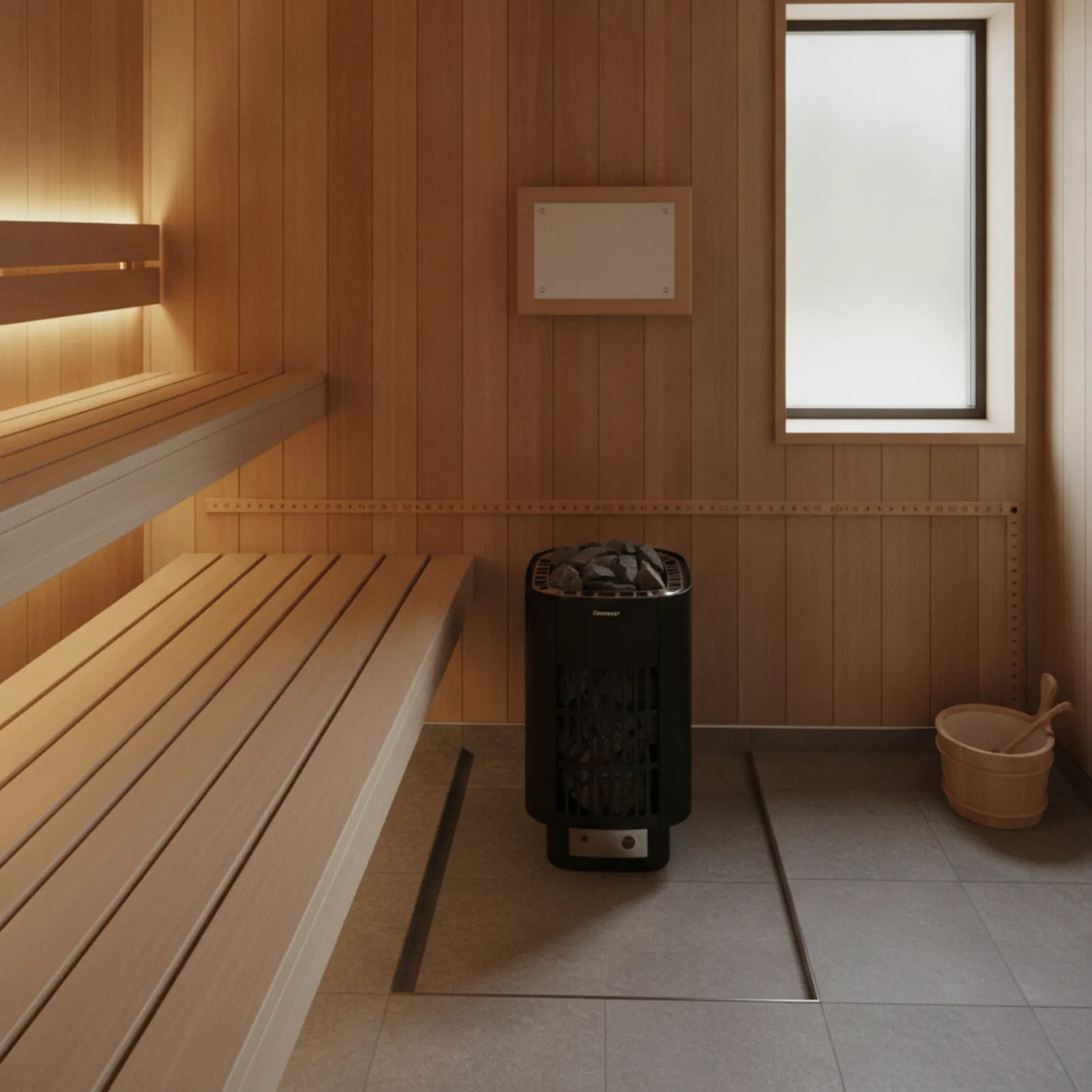
Sauna Heater Clearance Guide: The Spec You Cannot Ignore
A buyer guide to sauna heater clearances, guards, bench spacing, combustible materials, electrical work, and what to confirm before installation.
Installation
Quick answer: Sauna heater clearances are safety requirements, not design preferences. Confirm side, front, top, bench, guard, and combustible-material clearances from the exact heater manual before installation.
Best for
Buyers choosing a home sauna heater or reviewing a kit layout before install.
Wrong fit
Commercial sauna engineering or DIY electrical installation instructions.
Tradeoff
A larger heater or tighter bench layout can break the clearance plan even when the room looks good on paper.
"I had no idea the electrician alone would be $1,700. Nobody warns you about this." That is a real buyer on Reddit, and the heater is where that kind of surprise starts. The clearance spec on the heater you choose decides the room layout, the bench plan, and part of the electrical bill.
Here is the failure mode. A buyer designs the room, orders the kit, and the installer opens the heater manual on site. The manual demands more distance to the bench than the drawing allows. Now something has to move: the heater model, the bench, or a wall. Any of those after delivery costs $500 to $2,000 more than the same change on paper.
Quick Answer
Use the exact heater manual to confirm required clearances to walls, benches, ceiling, floor, guard rails, glass, and combustible materials. If the layout cannot meet them, change the heater, room size, or bench plan before installation, not after.
Where the clearance numbers come from
Heater clearances are not the installer's opinion. Electric sauna heaters sold in North America are tested to UL 875, the standard for electric dry-bath heaters, and each model is listed with the distances to combustible material it was tested at. Harvia, the biggest heater maker, prints its minimum safety distances on the rating plate, in the manual, and on every product page, and states plainly that they must be followed to avoid fire.
Two things follow. First, the numbers are per model, not per brand. Second, more power means more distance. A 9 kW heater does not fit where a 6 kW heater fits just because the room is the same.
Clearance checklist
Clearance point
Why it matters
Side walls
Combustible material protection
Front space
User contact and heat safety
Ceiling
Heat concentration above the heater
Bench distance
Prevents unsafe close seating
Guard rail
Reduces accidental contact
Floor mounting
Stability and the specified install
Electrical disconnect
Service and safety requirement
Stone loading
Manufacturer performance and safety
Exact model matters
Two heaters from the same brand can have different clearance rules. A wall-mounted electric heater, a floor-standing tower, and a wood stove do not share one layout. Wood-fired heaters need far larger clearances plus floor protection and a flue plan, one of several reasons the wood-fired vs electric guide tells most buyers to settle the fuel question first.
Do not design from a category. Design from the manual. If you are still choosing between makers, the Harvia vs HUUM comparison and the best sauna heater guide note where each brand publishes its install documents.
Bench layout can create the problem
A room can pass on paper and still fail in person. The classic miss: the room is big enough for the heater, but the bench plan puts knees, towels, or a child's reach inside the clearance zone. Heater guards exist for exactly this, and bench spacing and guard design belong in the same drawing. A glass wall next to the heater has its own spacing rules too, covered in the door and glass safety guide.
Start with the home sauna size guide for the room, then run the numbers in our sauna heater size calculator. If the heater the room needs cannot physically fit the layout with its clearances, you want to know before the deposit.
Electrical and heat safety are linked
Most traditional electric heaters need a dedicated 240V circuit, typically 30 to 60 amps, installed by a licensed electrician. That work commonly lands between $1,800 and $3,200 and varies a lot by region, which is why we keep a state by state electrical cost table. The sauna electrical planning guide covers panel capacity, GFCI protection, and the questions your electrician will ask.
Clearance and electrical live together because both are inspection items. A heater installed at the wrong distance can fail the same inspection as a heater on the wrong circuit, and both failures surface after the room is finished.
What to ask before you sign
Three things, in writing:
A layout drawing with the manual's clearances marked for the exact heater model on the quote. Not "it fits." A drawing.
Who pays if the inspection fails. If the dealer designed the layout, the dealer should stand behind it.
Confirmation that the model number on the quote matches the manual you were shown. Model revisions change clearances.
Sellers in our sauna brands directory who publish install manuals openly make this easy. If your quote shows a heater but no layout, send it through our free quote review and we will flag what is missing.
Frequently Asked Questions
Are sauna heater clearances universal?
No. They are set per model in the manufacturer's manual and the heater's UL listing, and local code can add requirements on top. Never reuse the clearances from a different heater, even one from the same brand.
Do I really need a dedicated 240V circuit or can I plug it into a regular outlet?
Most traditional electric heaters need a dedicated 240V circuit installed by an electrician. Most plug-in infrared cabins run on a regular 120V outlet. The sauna electrical planning guide covers which is which and what the circuit really costs.
Can heat shields reduce clearance?
Sometimes. Some manufacturers allow reduced distances with a specified shield, and some do not. It only counts if the heater manual says so in writing. An improvised metal sheet does not change the listing.
What size sauna do I need for two people without feeling cramped?
Roughly 140 to 250 cubic feet works for two, which usually means a 4.5 to 8 kW heater. Small rooms are where clearances bite hardest, so check the home sauna size guide for layouts and confirm the heater fits with its required distances before you commit.
These guides are built from manufacturer documentation, public specifications, primary research where health claims matter, and repeated buyer questions that show up in real ownership and installation decisions.
Manufacturer responses can clarify pricing bands, warranty terms, support footprint, or common mistakes. They do not move a page up the shortlist on their own.
Health and safety pages are written conservatively. When the safer answer is to slow down, get clearance, or skip the heat, that is the answer we give.